

A number of years ago we published an article asking if heat pump dryers were worth the extra costs, it was almost eight years ago in fact and the bottom line is that we said that, for most people, most of the time, they probably weren’t.
Eight years on has that changed?
The short answer is not really, it’s largely the same as it was all those years ago. But what gave rise to revisiting the topic is the uptick we’ve seen in people down the road trying to repair these machines on a DIY basis and what’s become patently obvious is that most people have no understanding of these machines at all.
What we think, and it’s anecdotal only; we’ve no hard evidence, is that a lot of people have thought that these machines are some sort of a magic bullet, a cure to the high electric costs of a dryer. Which if you read the original article here, you can see that won’t be the position for every use case.
But here’s some of the things we get asked about heat pump dryers and the answer that we hope will help some owners that have just read the marketing blurb and not looked into what it was they were actually buying.
I Need A New Heater
Bar, we think a handful of hybrid LG models, no heat pump tumble dryer has a heater in it.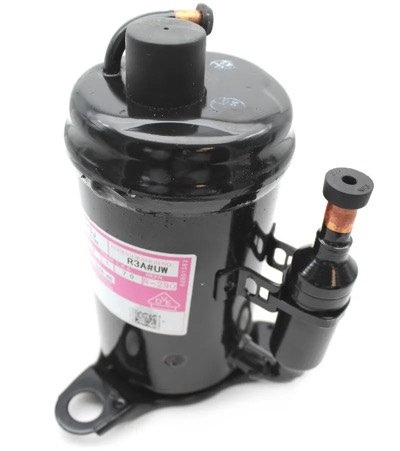
So, for the most part, there isn’t one there to change.
But people get a tumble dryer not heating and assume that there is a heater and thermostats in it.
They use a refrigerant heat pump system with a compressor, condenser etc to generate heat. In the simplest of terms, if works like a fridge in reverse. That’s also why they can’t get too hot.
Here’s where we get onto a bit of a Right To Repair Rant (again, we know), this compressors when they fail ain’t cheap! Not only that you cannot replace them on a DIY basis.
So, in order that service techs (who don’t have refrigeration skills) can fix them makers have a strong tendency to supply a complete refrigerant unit with the whole lot in one big unit and, you guessed it, that’s criminally expensive. Most of the units will be in the hundreds of pounds, not at all unusually half or more the cost of a replacement dryer.
Guess how many people change those out of warranty?
I Need A New Thermostat
Again, we will be asked for heater thermostats when, if there is no heater, there are no thermostats.
However, due to their complexity and general workings, these machines are all electronic and use sensors, not thermostats.
There may be a protection stat used in some but that’s about it.
Then people start to guess and will often ask, what sensor do I need to change? To which the rolling eyes answer has to be, how can we tell you that there are often several in these machines and we’ve no idea what one could be faulty or if it even is a sensor problem?
Getting Into Them
Often the hardest part of preparing any appliance is figuring out how to get into them, without breaking stuff on the way and, then putting it back together.
The actual changing part is normally the easy bit of the process, asides from diagnosing what’s needed of course.
But these types of tumble dryers are ram packed full of stuff, there is almost no room at all to work in them, often meaning an almost complete strip down to replace even the simplest of internal items.
Due to that a lot of people just give up, they’re too hard.
Environmental Issues, For Us
All this leads us to the environmental side again and, if we’re sounding like a stuck record, sorry but it’s worth saying time and again that if repairs are too hard, too expensive and so forth that people will just scrap the machines.
If people scrap the machines and the overall lifespans are shortened, then any environmental benefits from the energy use are almost bound to be dwarfed by the energy costs of disposing of and recycling these machines.
And that’s not even considering the extra energy and materials needed to construct them.
So it’s all well and good saying that you save 60% electricity or whatever the claim is in use, it’s a pointless claim unless you compare like with like over the whole lifespan of the product, from cradle to grave as it were.
Long Term Reliability
From what we have seen these machines seem to be fairly reliable on the whole, from our experience no more or less than normal tumble dryers.
The big “BUT” is that when they do get on a bit and things start to break, which they will, these heat pump tumble dryers are massively more costly and difficult to repair. And, that’s if it’s even worth and you can get the parts to fix it.
This again plays into the costs that we mentioned in the first article, as even if you insure these machines, they tend to carry a higher cost to do that because they cost more to repair or replace.
So whilst you may get a warm fuzzy feeling about saving the electricity that these tumble dryers are supposed to, it really isn’t just as simple as that.
Consider What You Need
Simply put, that’s our advice.
You really need to think about how you will use your tumble dryer before you buy one and don’t, please, whatever you do, don’t just buy one based on some marketing blurb about saving a ton of electricity.
Many people will be perfectly fine with a heat pump tumble dryer and if it works for you, that’s great.
But, many people won’t be happy with one.
If you need a fast dryer, you’re not going to use your dryer a lot and so on then a heat pump tumble dryer may well not be suitable for your use.
If you dry a lot sequentially with multiple loads then maybe a heat pump dryer would be better.
There is however, no point in spending all that extra cash to get a heat pump dryer if you don’t really need it as you don’t use it often enough or want to try to self-repair it.