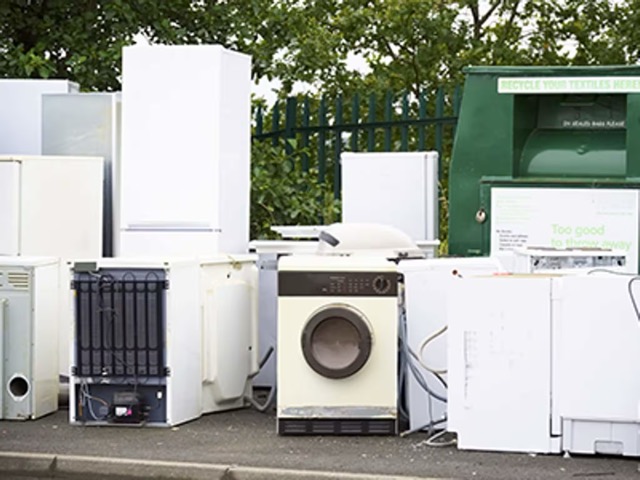

New data has revealed that half of all CFC gases from UK waste fridges could still be being emitted into the atmosphere.
The figures have been issued to the fridge recovery quality assurance association RAL by the Department for Environment, Food and Rural Affairs. RAL says the figures suggest that only 47% of UK fridge CFCs are being recovered. Some industry experts have also strongly criticised the government and the Environment Agency for not introducing minimum standards for CFC recovery from fridges.
Despite the widespread feeling that the “fridge crisis” is now over, with the UK dealing with its waste fridges under European Ozone-Depleting Substances regulations, DEFRA has told RAL that the UK is still only recovering 352 tonnes of CFC gas each year.
RAL estimates that 2.5 million CFC-containing fridges are being processed each year, with each unit containing about 398g of CFCs, and considers this means that only 47% of UK fridge CFCs are being recovered.
Commenting on the “pathetic” levels of CFC recovery being seen in the UK, RAL’s UK director, Jeff Weeks, said: “We now have the results that were predicted and feared. The UK government got it badly wrong when setting its so-called ‘standard & issuing’ licences to fridge plants or other operators who collect and extract CFCs.
“This is a clear indication that DEFRA needs to implement a series of measures including performance targets for recycling plants and improved transparency of results,” he added.
Damage
CFCs ““ chloro-fluro-carbons ““ are non-toxic gases that have historically been used as coolants in fridges. When emitted into the atmosphere, they break down to release chlorine, which damages the sun-protecting ozone layer. A single chlorine atom is thought to destroy over 100,000 ozone molecules.
Despite the European Union’s Ozone-Depleting Substances (ODS) regulations for fridge disposal, experts in the fridge recovery sector have been concerned for months that there are insufficient standards on CFC recovery in the UK.
Graham Davy, managing director at Sims Group UK, which has the world’s largest fridge recycling plant at Newport in South Wales, has issued a number of warnings in recent weeks over the issue.
Mr Davy said that since the fridge recycling market is driven by cost, and it costs money to recover CFCs from fridges, some fridge processors are making the wrong choice between operating in a competitive marketplace and saving the Ozone Layer.
Appalled
Mr Davy said: “I am appalled that something as simple as a minimum standard for ODS recovery per fridge has not yet been put into place by the Environment Agency, and that, as a result, ODS is not being captured as efficiently as possible. It is taxpayers’ money that is paying for a service that should be striving to protect out environment for future generations.
“There is always room for competitiveness, but it should not be at the cost of the environment,” he said.
RAL believes that although only 186g of CFCs are being removed from the fridge foam of each unit in the UK on average, a minimum standard must be set at a minimum of 283g per unit, with the minimum recovery of CFCs from refridgerants set at a minimum of 115g per unit.
But, Sims Group’s Mr Davy said he feared the government is “reluctant to take robust action”. He said: “the government wants rid of a problem that it has created ““ mountains of fridges doesn’t exactly promote a picture of positive environmental policy to the voting public, does it? Well, neither does the continued emission of ODS gases as a result of poor guidance.”
From Let’s Recycle