
Home › Forums › Trade Technical & Spare Parts Forums › Trade Technical Enquiries › Towel Rail Heater
- This topic has 3 replies, 3 voices, and was last updated 15 years, 4 months ago by
Phidom.
-
AuthorPosts
-
November 14, 2010 at 9:53 am #58830
Phidom
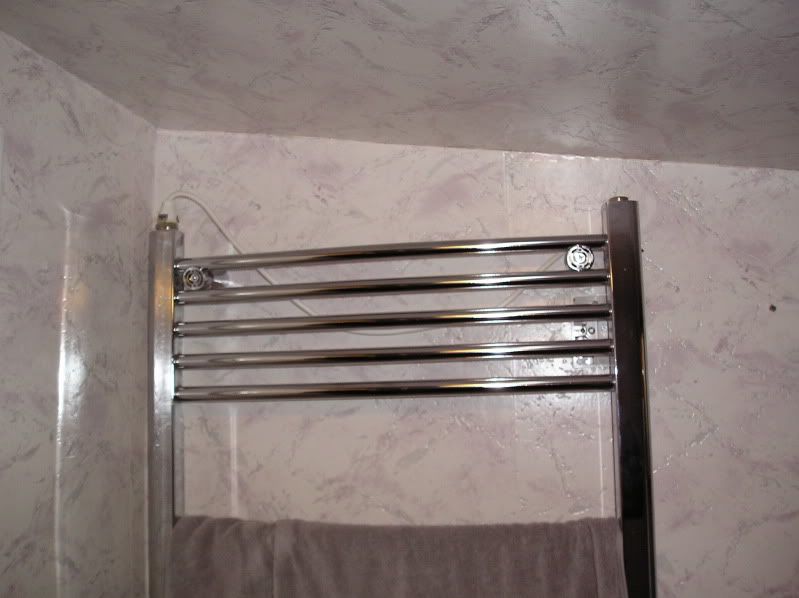
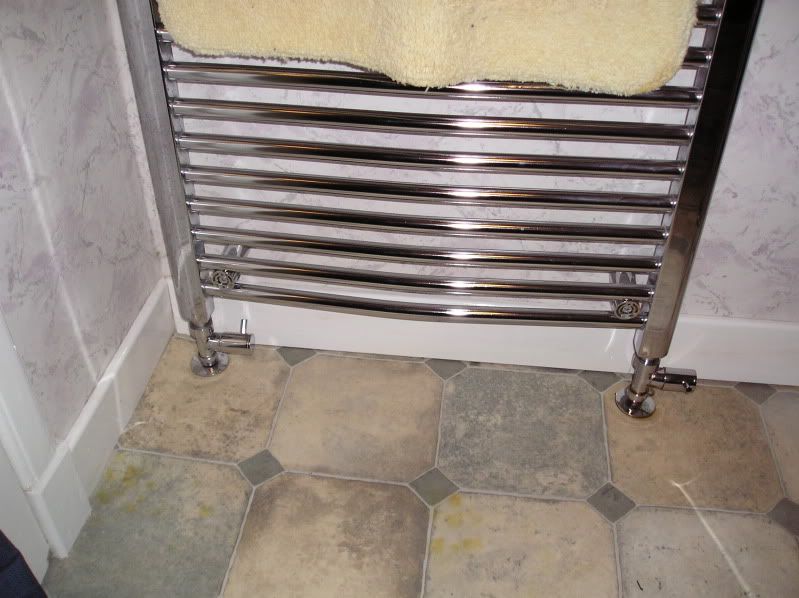
ParticipantI recently replaced my old electric heated towel rail with a tall towel rail radiator, plumbed into the central heating. In case I want towels dried when the heating is off I also fitted an electric towel rail heater element, a tubular heater that goes into one of the valve holes in the radiator. The new pipes had to run under the floor so they come up vertically into the radiator. This meant I could not readily mount the element at the bottom of the radiator with a tee for the water connection. I was not sure how you would arrange a valve with such an arrangement in any case. It therefore seemed sensible to mount the element at the top of the radiator in place of the supplied blanking plug i.e. like a normal cylinder immersion heater. When I plumbed in the radiator I initially ran it with the central heating but when I went to bed I turned off the heating and turned on the electric heater to try it out overnight. I woke up at about 4 am to total darkness, my LED alarm clock was not on. I tried the bedside lamp but that was similarly dead. On investigation I found the sockets MCB had tripped. By a process of elimination I traced the fault to the new towel rail heater which was shorted to earth.
I’ve now looked at the instructions 😳 and it says:“. The heated towel rail must always be mounted with the element at the bottom with the heated towel rail in the upright position. Failure to do so may result in a fire hazard.”
This statement is actually ambiguous but by bottom I think they must mean the appliance goes on the bottom of the radiator rather than the element end of the appliance being at the bottom and the cable end at the top. The heater is a sealed unit so I don’t know what kind of thermostat is used. I’m wondering if this is some kind of bodged design and the heater is intrinsically unsafe.
 November 14, 2010 at 10:52 am #335813
Brains
ParticipantRe: Towel Rail Heater
In my considered opinion, the element should be mounted at the lowest point.
Take a look at this link to the Dimplex website… http://www.dimplex.co.uk/products/domes … /index.htm
You can see that the lement is at the bottom of the towel rail.
You should contact the manufacturer and verify the installation requirements.
The installation looks new. As an aside, do you have all the appropriate electrical certification in accordance with with Building Regulation Part P? You may need to go back to the installer.
Regards
November 14, 2010 at 11:25 am #335814Martin
ParticipantRe: Towel Rail Heater
Phidom wrote:The heated towel rail must always be mounted with the element at the bottom with the heated towel rail in the upright position. Failure to do so may result in a fire hazard.”
I agree with Brains here in that the dual fuel electric element has to be fitted at the bottom of the radiator using a ‘T’ pipe dual fuel adaptor. Unfortunately judging by your installation, adding a T Pipe to the outflow of the radiator is not possible due to its height from the floor.
The only possible solution would be to allow the water inlet (or outlet) pipe to fit where the element is right now, up and out through the ceiling and instal the heater in the spare bottom fitting.
Aside from that, there doesn’t appear to be any space to allow raising the radiator to allow this so, sadly, you may have to disconnect and discard the element and put a blanking plug in its place. 😥
November 14, 2010 at 12:48 pm #335815ParticipantRe: Towel Rail Heater
Brains wrote:
The installation looks new. As an aside, do you have all the appropriate electrical certification in accordance with with Building Regulation Part P? You may need to go back to the installer.
Regards
There is no Part P in Scotland. In any case, the fused spur mounted in the kitchen which supplies the cord outlet in the bathroom was there already as there was a wall mounted radiant heater there before.
If the heater can’t be mounted at the top I would like to know the reason. I suppose it could be that with any radiator there is a risk of air build up at the top so you can’t guarantee total immersion of the element at all times. This can’t happen with a cylinder immersion heater as hot water can only come out of the top when cold water enters at the bottom to replace it.
-
AuthorPosts
- You must be logged in to reply to this topic.