
Home › Forums › Public Support Forums › Help And Support › Washing Machine Help Forum › Operating an automatic, compact, washing machine
- This topic has 35 replies, 5 voices, and was last updated 19 years, 4 months ago by
ukthesis.
-
AuthorPosts
-
November 18, 2006 at 1:31 am #195418
Trilobite
ParticipantRe: Operating an automatic, compact, washing machine
I think you’re still thinking as if you are operating a twin-tub 😀
The machine will do things AUTOMATICALLY – by itself! 😉
“Long Spin” refers to the final spin in the COTTONS programmes. Usually lasts between 6 and 10 minutes. The speed will increase in steps.
“Short Spin” refers to the EASY CARES & DELICATES programmes. Usually lasts 2 – 3 minutes. “Rinse hold” is usually available as standard.
“Rinses ” refers to the sequence of rinsing after pumping out the wash water. If you hand wash items in the sink, the machine can rinse alone, then spin.
“Rinse” means the last rinse, before spinning. This adds fabric conditioner automatically.
“Rinse Hold” means the clothes are left drifting in the final rinse water, to reduce creasing. You will have to perform an action in order to get the machine to drain and spin; usually pressing a button, or turning the dial.
“Drain” simply pumps out the final rinse water (if on rinse hold), but does not spin. Useful for drip-dry items only.
November 18, 2006 at 3:10 pm #195419ukthesis
ParticipantRe: Operating an automatic, compact, washing machine
There’s a separate temperature control knob, but no timer.
I’m still not quite clear. I set the dial on “1” for cottons. Does it then “automatically” know which other settings to use? In which case, why do they bother to include these other settings as symbols on the dial, rather than just letting the machine do it’s own thing without human interventions (or confusing the likes of me)? Seems like they are there so that I can exert some control over the process myself, as options I can set myself. But that begs the question – Iif I “start off” on the 1 setting, when/how do I switch over to one of the other settings?
November 18, 2006 at 5:12 pm #195420ParticipantRe: Operating an automatic, compact, washing machine
Right, first things first…
You will notice that garments have a ‘care label’ attached. This shows the setting to use for a particular item. The washing machine will have corresponding settings upon its dial. The instruction manual should also have a page or two explaining the settings.
The dial will probably be separated into sections: COTTONS, SYNTHETICS/EASY CARES, and DELICATES, and probably WOOLLENS
COTTONS gives maximum agitation, wider temperature range, maximum spin.
SYNTHETICS/EASY CARES has reduced agitation, reduced temperatures, and reduced spin speeds.
DELICATES ditto above.
WOOLLENS has a much reduced agitation (note the ‘broken bar’ under the tub), temperature that is usually limited to 40 degrees, and an intermediate spin. Spin speed is limited to 800rpm.
SHORT SPIN should give approximately 600rpm spin over 2 minutes.
LONG SPIN should be 2 mins @ 600rpm, then 2 mins @ 800rpm, then 2 mins @ 1000rpm.
Woollens spin might not be selectable on its own, but the machine will perform as LONG SPIN above, but will turn itself off after the 800 rpm mark.
Most folk just use a few of the programmes:Typically, “Non-fast Coloured Cottons” @ 40 degrees C.
This might be numbered “5”, or show a wash-tub symbol which has “40 degrees”. This programme is suitable for cotton towels, T-shirts, cotton undies, socks, etc.Find that setting upon your dial; turn the temperature dial to 40 degrees C; load laundry, detergent (and conditioner); press Start or On; the job is done. The machine will take in the required amount of water automatically, heat the water automatically, wash automatically, rinse automatically, and spin automatically. The programme dial should click round as it goes through the programme.
Another programme that people use is “Delicates”. This is similar to the example above, but has a bar under the tub symbol. This indicates that the agitation is reduced, i.e. not as vigourous. This programme may stop at the final rinse: you will have to tell it to pump-out and spin.
November 18, 2006 at 6:42 pm #195421ParticipantRe: Operating an automatic, compact, washing machine
I posted a reply, but I’m not sure if if came up.
Mine only has the two dials, the temperature and setting. No self-timer.
I’m not quite clear about this. You seem to be saying that I can leave, in the case of Cottons, the dial on 1, and the machine will take care of the rest. So I can forget the symbols I told you about. But they were fixed onto the machine for a purpose, probably to offer users a choice and options. So it’s expected that users will exercise discretion and use these other settings I noted, as well as the numbered ones (1 for Cottons, 2 for Synthetics, etc.).
Which, if this is true, brings us back to the original issue. When and how are these settings, with those other symbols I told you about, used? If I set it to 1 (Cottons), how can I also set it to one of the others? Or does the machine stop, waiting for more “instructions” from myself about what I want it to do next (ie switch it to one of the other symbols)?
Cheers.
November 18, 2006 at 6:44 pm #195422ParticipantRe: Operating an automatic, compact, washing machine
Please ignore my last email. For some reason, when I first went to the forum, your last post didn’t come up and mine didn’t come up either. I went back to it, and they both came up. So please don’t bother answering the post I just sent. Cheers.
November 18, 2006 at 7:13 pm #195423Penguin45
ParticipantRe: Operating an automatic, compact, washing machine
This is your machine:
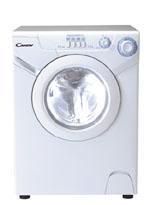
It’s a pretty conventional (albeit small) automatic washer. The timer is set by the large r/h knob. After you start the machine, the timer will drive the dial around the selected programme to the finish point. The various symbols which have been mentioned will gradually pass the 12 o’clock position and indicate the wash status.
You should not need to touch the dial once the programme has started – it’s all “pre-programmed” by the timers start position.
Patience may be required – a typical cotton wash can run for 1.5 – 2 hours on a modern automatic machine.
Regards,
Penguin45.November 19, 2006 at 11:26 am #195424ParticipantRe: Operating an automatic, compact, washing machine
On the operation of the programme dial, which is causing me the problem. Now, a friend recommended I set it to “1” because my fabrics are cotton. The Instruction booklet says I should use the 1 setting for cotton and linen. However, someone else advised I set it on the “rinses” symbol, not on 1. The rinses symbols is for cotton only.
Let’s assume then that I only want to wash cotton (cotton only). In this situation, I don’t set it to 1. I set it from the beginning to the Rinses symbol, before turning on the machine. Then I just let it go and I don’t alter this setting at all, until the job’s done.
Is this the right idea? I follow the same practice for the other types of laundry, right, using the Instruction Booklet to see which symbol, or number, corresponds to which type of laundry required to wash and rinse?
Cheers.
November 19, 2006 at 11:46 am #195425Martin
ParticipantRe: Operating an automatic, compact, washing machine
ukthesis wrote:However, someone else advised I set it on the “rinses” symbol, not on 1. The rinses symbols is for cotton only.
I think someone is winding you up on that one?
ukthesis wrote:using the Instruction Booklet to see which symbol, or number, corresponds to which type of laundry required to wash and rinse
Now who is winding who up here?
Set the dial as per the user booklet. Seperate cottons from synthetics, woollens from acrylics. Look up the wash symbol that relates to those garments, select the corresponding position on the dial and switch on…. 😀
Easy! :tup:
November 19, 2006 at 3:49 pm #195426ParticipantRe: Operating an automatic, compact, washing machine
Thank you very much for your help. I take it that you repair washing machines?
November 19, 2006 at 4:43 pm #195427ParticipantRe: Operating an automatic, compact, washing machine
Martin and myself are both professional repairers.
Good luck with it – it’s a doddle once you get your head round it.
Regards,
Penguin45.November 20, 2006 at 9:51 am #195428ParticipantRe: Operating an automatic, compact, washing machine
For Cotton only, the instruction booklet gives no recommendation for the temperature. What would you advise for the temperature?
It also notes a “32 minute Rapid Programme” The complete washing cycle is done a lot quicker, it says, but some changes have to be made (thankfully, these are clearly explained). But are there any drawbacks to this “rapid” programme? Otherwise, I am tempted to use it all the time. Why wait 1.5 – 2 hours, when it’s done in half an hour?
November 20, 2006 at 12:40 pm #195429ParticipantRe: Operating an automatic, compact, washing machine
ukthesis wrote:What would you advise for the temperature?
The link below will answer all that and more….. 😉
November 20, 2006 at 7:55 pm #195430ParticipantRe: Operating an automatic, compact, washing machine
I have the hang of it. But there is a problem. I bought the machine, new, about 2 weeks ago. According to the Instruction Booklet, the filter should be cleaned out at least once a month. It’s situated on the bottom, right of the machine. There’s a wheel that you turn anti-clockwide to release the filter. BUT I can’t get the wheel to turn, or to move at all. It seems to be stuck. What do you advise? Cheers.
November 20, 2006 at 8:04 pm #195431kwatt
KeymasterA warranty call if it’s stuck would be the best bet. 😉
K.
November 20, 2006 at 8:06 pm #195432ParticipantRe: Operating an automatic, compact, washing machine
ukthesis wrote:I bought the machine, new, about 2 weeks ago. It seems to be stuck. What do you advise?
Your trials are endless it seems? Clearly in this case the manufacturers will now need to become involved in order to rectify the problem under the terms of their guarantee.
….and for your convenience, here is their website, please contact them A.S.A.P : –
Good luck, and do let us know the outcome won’t you? 🙂
-
AuthorPosts
- You must be logged in to reply to this topic.