Bloomberg and other have today reported that General Electric have been said to perhaps be selling or seeking a partner for the unit that makes refrigerators and washers, ending more than a century in an industry.
GE, the biggest maker of appliances for new U.S. homes, hired Goldman Sachs Group Inc. to explore options that include a spinoff or auction. A sale may bring $5 billion to $8 billion, the Wall Street Journal reported yesterday.
Gary Sheffer, a company spokesman, declined to comment on a possible sale.
“This isn’t a piece of business at this point that has got much more incremental opportunity for GE,” said Nicholas Heymann, an analyst at Sterne, Agee & Leach Inc. in New York, who has a “hold” rating on the stock.
GE’s shares fell 13 percent, the most in two decades, on April 11 after Immelt reported a 12 percent decline in first- quarter earnings and said annual profit would trail his $2.42-a- share target. GE changed its forecast to $2.20 to $2.30 a share.
Welch told the GE-owned CNBC network that the surprise had jeopardized Immelt’s “credibility” and later followed up to reiterate his support for the CEO. Welch had divested the small- appliance business, which made products such as toasters, and consumer electronics in the 1980s.
History With Appliances
Since its inception in 1892 through the merger of the Edison Electric Co. and the Thomson Houston Co., GE was usually first to introduce appliances, from the room air conditioner to the two- door refrigerator-freezer combination, according to its Web site.
In 1928, GE introduced the Calrod electric range and about 19 years later came out with the first completely automatic clothes washer. In 1969, it introduced the first side-by-side refrigerator-freezer with an ice and water dispenser in the door.
A sale would continue consolidation in the U.S. appliance industry and provide a possible vehicle for overseas companies looking to grab a larger share of the U.S. market.
Valuation
The biggest recent acquisition of an appliance company was Whirlpool Corp.’s purchase of Maytag Corp. in 2006, creating the world’s biggest appliance maker. The final sales price excluding assumed debt was $1.68 billion, or about 8.4 times Maytag’s Ebitda in its final four quarters, according to Bloomberg calculations.
Haier Group, China’s biggest appliance maker, was one of the unsuccessful suitors in the bidding for Maytag. South Korea’s LG Electronics Inc. and GE said in February they would share patents on cooking appliances and refrigerators. Sally Lee, a spokeswoman for Seoul-based LG Electronics, declined to comment on the GE report, as did Zhao Rui, a spokeswoman at Haier Group in Qingdao.
“Haier would definitely be interested because they’ve been trying for years to get a bigger share of the U.S. market,” said Zhang Xiaoga, an analyst at Orient Securities Co. in Shanghai. He has an “add” rating on the company’s Qingdao Haier Co. refrigerator and air conditioning unit listed in Shanghai.
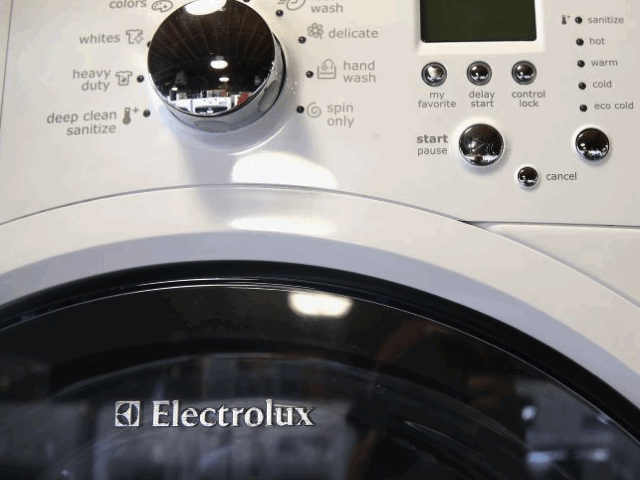
Stockholm-based Electrolux AB, the maker of Frigidaire appliances, in April reported its first quarterly loss in more than two years because of the slowdown in the U.S. Electrolux spent 120 million kronor ($20 million) in the first quarter to introduce new products in the U.S.
Despite all of this though it is hard to imagine that Haier, Whirlpool or Electrolux could raise the money being asked for to buy GE since all are facing a massive downturn in sales and will, no doubt, be pulling in their horns as it were. And, whilst GE is a large player in the USA they are not as large a player in Europe or other areas as their large appliances are not particularly well suited to small European kitchens. But, we could be wrong, we’ll see.