

Is Direct Drive Better
Are you being swayed by the pitch for a direct drive washing machine, we explain what it is
We often get asked about direct drive by people most often in relation to why or whether another washing machine is or is not a direct drive model which usually ends up in us having to explain the differences and sort the facts from fiction.
The hype around direct drive would have you believe that it was the answer to prayers and stops belts snapping or stretching etc. but, the reality is that these are actually very uncommon failures in a modern washing machine, By modern, we mean anything from about 1983 onwards.
A typical direct drive system, compared to a indirect drive is compared like this:
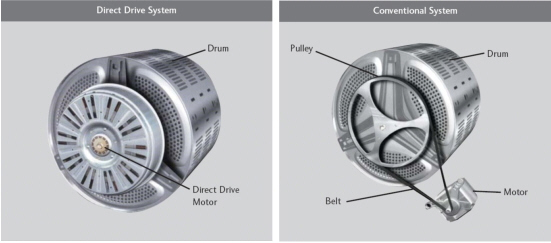
One manufacturer of direct drive washing machines goes so far as to claim that “The surface texture of the drum increases the amount of contact with the fabric. This creates a better washing action and removes more dirt and stains, giving clothes a deeper clean.” Huh, how does what method is employed to turn the drum have any effect on the clothing inside it in that way? The answer is, in case you didn’t realise, that it cannot and does not.
The marketing goes on to say that; “Sensors detect the weight of the load; adjust the temperature and measure out the correct amount of detergent for the best washing performance. This not only saves you water and energy but also ensures optimum washing performance.”
Yes and most other washing machines on the market also have these sorts of sensors, certainly any half reasonable washing machine will have and all upper market models will do, probably more accurate as well. Basically, it’s marketing rubbish there is no advantage at all here to be had by using direct drive over indirect drive.
Selling Points Of Direct Drive
LG sell their direct drive washing machines on the following major points:
Less parts means less trouble, less vibration and less noise
What is failed to be pointed out is that you also need to add additional sensors and that there actually isn’t less parts as such, just different ones.
LG’s Direct Drive works without a belt and a pulley to reduce wear and tear and increase durability
Not in our opinion, belts and pulleys on reasonable quality washing machines (which you can get for the same sort of money) are parts that very, very rarely fail. Where they do fail it tends to be through continual overloading etc. and a direct drive system is no less susceptible to failures from the same pattern of use.
The motor is attached directly to the centre of the drum via magnets making it more stable, therefore reducing vibration
Again, not in our experience.
Vibration is caused from improper levelling or a poor installation and bad loading or overloading, not by the motor system employed. It could perhaps be argued that this is the case when you run the washing machine completely empty but, we don’t know many customers in the real world that actually do that or, would even want to.
The brush has been removed which dramatically reduces the amount of friction and therefore makes the washing machine extremely quiet
This is true.
Using a brush-less drive motor does substantially reduce noise and also removes a point of failure (carbon brushes) but you can get exactly the same from a conventional induction motor, you don’t need to be forced into a direct drive model to have this advantage. However, washing machines with induction motors tend to be more expensive than ones with a brushed motor (just like direct drive models) as they require a more expensive motor and an inverter card to drive the DC motor.
In short, there’s a whiff of truth and a lot of marketing hype that doesn’t stand up under scrutiny in the direct drive argument.
The Bad About Direct Drive
A direct drive washing machine also has disadvantages. One of which is this:
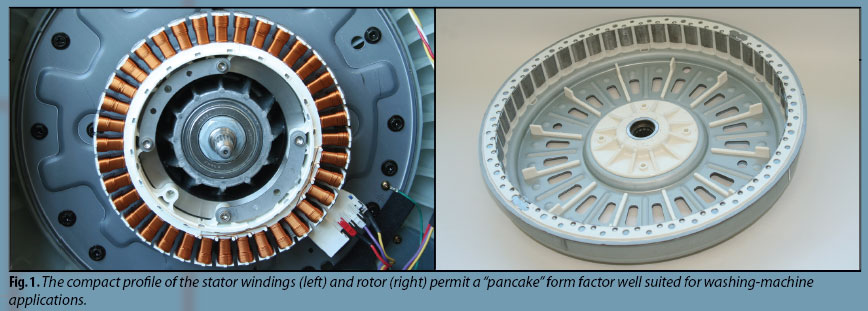
As you can see the direct drive part is actually quite a chunky affair that stands quite proud of the rear of the washing machine drum.
This, despite claims to the contrary, restricts the depth of the drum on a standard European sized washing machine meaning that the actual “usable” depth of the drum is limited. Where we see this coupled with constant claims of increased drum capacity it makes us wonder about the validity of the claims.
You can also see the additional “hall sensor” that is used additional mounting points and so on. There really aren’t less parts as we said earlier, just different ones.
But, for some reason that we cannot seem to fathom or get to the bottom of, direct drive machines seem to suffer from more bearing failures. Quite why that is, we don’t know but at a guess, it’s got something to do with all that weight on the back of the drum.
Direct Drive Washing Machine Stability
One of the big claims for direct drive is that it makes the washing machine more stable but, to be blunt, it isn’t true.
It is also fair to say that, despite claims of increased stability that concrete weights are still employed to balance the machine internally. If it were a super duper slam dunk cure then it wouldn’t need those you would think but, you’d be wrong.
The part of the wash process that creates the most vibration (and noise) is unsurprisingly the spin cycle where the machine ramps up to pretty high spin speeds and, when you have a bunch of clothes spinning around at those sorts of speed the forces that are in play are pretty big. This will cause the drum to oscillate to some degree and produce vibration. Without finding a way around the laws of physics you cannot avoid this, you can only control it and on more expensive machines you will see better weights, better dampers, better springs to soak up that vibration and make the washing machine more stable and quieter.
On cheap machines poor quality components are used and this leads to higher levels of vibration and noise.
It’s common sense really and, direct drive or not has pretty much nothing to do with it. Direct drive certainly offers no quantifiable advantage in this area.
Bottom Line
The bottom line is that there is little to no advantage to be gained from having a direct drive washing machine over an indirect drive one.
Despite the claims made for direct drive, under scrutiny, few if any actually stack up and make any sort of actual sense and, to anyone with even a modicum of engineering knowledge in relation to washing machines, it makes no sense at all and actually introduces other issues.
Which is probably the reason that most mainstream manufacturers, despite the technology having been around for a long time, have steered clear of the direct drive system and why not one of the top end manufacturers use it.
That pretty much says it all really.
But of course you are free to disagree with our assessment of the supposed benefits of direct drive, some people have in the comments below and we respect that however, to date, there has been no compelling case made for direct drive in our opinion only what appears to be largely the same sort of stuff we see in marketing materials to try to justify its existence.
It is not innovative at all, it’s just a different way of doing exactly the same thing.
Great explanation I have been looking for with no luck so far ! Thanks
The motor is much better in my view from a mechanical setup or capacitor start type motor in that its got only one moving part. The computer running it is more expensive to repair though, but as far as drum sizes goes, I feel the customer only takes notice of the actual size of the drum and as a comparative difference between say seven or eight kilo machine.Capacitor start motors, while reliable are probably not as reliable as the Stator type motors.
Very informative! Thanks a lot! I have been contemplating whether to buy a direct drive washing machine or not. Now it’s clear. God bless 🙂
Great explanation about direct drives. I always thought DD were supposedly top-notch and worth the extra, but after reading this clear & concise report i think I’ll give them a miss. The last sentence sums it up beautifully in which it says that all the major manufacturers have never bothered with DD and so it appears I will not bother too. Excellent, informative and well explained.
Whilst MOST of the above is true, there’s a couple of facts missing: the reason not many of the mainstream manufacturers have used direct drive is for patent reasons – they can’t. Secondly, brush motors are a bane. The brushes wear out and wreck the motor (unless replacement schedule is in place and stuck to – rather rare!), and motors are usually not far south of half the replacement cost of the whole unit.
This is the second part of a comment that was too long – look at previous post. We had a Bosch, it did an excellent job but the motor keeps wearing out brushes, it also sounds like a jet taking off. We upgraded to a Samsung, and couldn’t be happier. It’s considerably quieter (due to the brush issue, not just because it’s direct drive as correctly pointed out above), and vibrates/shakes a lot less. With the vibration, there is a reason why it is less: with the motor attached to the drum, there is a considerable amount of inertia imparted to the drum due to the motor weight, I haven’t noticed this mentioned elsewhere. It is the same priniciple as used on vehicles – to have the ‘sprung weight’ to ‘unsprung weight’ ratio as high as possible to get the best ride. I hope this helps someone!
Glen,Did you consider that the Bosch was perhaps several years old and that was a cheaper model with a brushed motor rather tun brushless as the more expensive models are.And, perhaps consider that the Samsung might just be not very good.
The bearing failures could be preceeded by seal failure. That is main reason for water getting into the bearing housing and then water washes out the lubricating grease and the bearing fails due to water rusting the bearing and mechanical movement without lubrication….
[quote name=”Kenneth Watt”]Glen,Did you consider that the Bosch was perhaps several years old and that was a cheaper model with a brushed motor rather tun brushless as the more expensive models are.And, perhaps consider that the Samsung might just be not very good.[/quote]Kenneth – the Samsung is an awesome machine. It has a very large door and larger capacity than any Bosch in the same form factor. (8.5kg vs 8.0kg) Also, not mentioned earlier, the motors in belt drive units run at prodigious speeds – wearing out the bearings eventually. This is regardless of whether they’re brushed or not. Our units get a lot of use (say 14-15 washes/week) and the bearings are worn out every two years as well. I’m not rubbishing Bosch, only saying that I’m completely sold on direct drive.
I wouldn’t believe the load sizes that either LG or Samsung declares…http://www.ukwhitegoods.co.uk/help/buying-advice/washing-machine/3311-are-washing-machine-load-size-ratings-the-truth.htmlDirect drive burn through bearings as well, no difference really. But, we sell more bearings for direct drive LG machines than we do for Bosch yet Bosch outsells LG. You don’t have to be a math genius to work out that something isn’t right there.Brushed or brushless motors will have zero effect on bearings.Samsung is an unknown in laundry as the volumes are low and people seem to scrap them when they go wrong, probably due to high spares cost and limited availability.
[quote name=”Glen M”] With the vibration, there is a reason why it is less: with the motor attached to the drum, there is a considerable amount of inertia imparted to the drum due to the motor weight, I haven’t noticed this mentioned elsewhere. It is the same priniciple as used on vehicles – to have the ‘sprung weight’ to ‘unsprung weight’ ratio as high as possible to get the best ride. [/quote]the motor is always part of the ‘sprung weight’, regardless if it’s direct drive or belt drive. (This is true even for cars.) The belt drive motor is bolted rigid on the tub, so its weight acts as a piece of concrete.
The rotor of a DD motor is relatively light-weight compared to the pulling force of a belt.Could the puling-force be a better counter-weight to the drum, thus making the bearing-load more symmetrical?
This is very helpful information. I didn’t know what to make of these direct drive machines, but now I see it’s just a ploy for new players to gain market share.
LG DD drives come with a 10 yr warranty.this site does mention that it does not include labour but the parts are covered.So 10 yr warranty, is about the exoected life of a washing machine of this range or any Bosch for that matter.
I have an LG that has a DD that broke after about 3 years. There is a 10 year warranty on parts not labor. The problem is that it is so much work to fix that the labor costs $800. The company will not cover the parts unless you use one of their repair companies. That is a HUGE con for direct drive. It’s so much you might as well buy a new washing machine.
[quote name=”Glen M”]Whilst MOST of the above is true, there’s a couple of facts missing: the reason not many of the mainstream manufacturers have used direct drive is for patent reasons – they can’t. quote]Glen….do you really think that non of major manufacturers didn’t think about DD for last 50-80 years?????……some LG…PG….HG from Korea in last couple of years is “invented hot water”!? Don’t be silly….this is just unscrupulous marketing of weak manufacturer! that things should be punished by law!
There’s something I didn’t understand in your article. You say “However, washing machines with induction motors tend to be more expensive than ones with a brushed motor (just like direct drive models) as they require a more expensive motor [I agree with everything up to here] and an inverter card to drive the DC motor.”But surely, an induction motor is, by definition, an AC motor. The first item on a Google search says “An induction or asynchronous motor is an AC electric motor in which the electric current in the rotor needed to produce torque is obtained by electromagnetic induction from the magnetic field of the stator winding.”Also, an inverter is a device (usually a high power electronic 50Hz oscillator) that produces AC, in order to run an AC device (such as a motor) from a DC source (such as a battery). None of this applies to a washing machines, unless it is for one that works away from the grid on batteries charged by a generator or wind turbine, etc.
We bought our washing machine exactly 2 years ago,the main reason we chose LG DD was due to the fact that it make less noise!!.the unit started to be extremely noisy in the spin mode about 2 mounts ago and there is no point of repairing it as the cost is so high .These high reputable manufacturers such as LG can get away with this. I for one will not buy another LG as all other WM had at least worked for 4-5 years without any problems.
You may find that the invertor driven motors suffer bearing failure from circulating shaft currents. Nothing to do with mechanical loading, but all to do with inadaquate electrical design. Something electrical machines specialists are quite familiar with.
My Samsung is working over 8 years, i still dont have issues.Less sound, less vibration. Well i prefer the belt one, as it proved its durability over decades. And i believe new models became better than mine. 🙂