

It has come to light today in the national newspapers as well as on the web that there has been a problem in Manchester that has led to the production of a huge fridge mountin of over an estimated 120,000 fridges. Most of the national newspapers seem to have picked up on the story as well as the BBC, but until it reaches crisis point like this, no-one simply seems to care about the environmental issues raised by the disposal of products from the whitegoods industry.
The sad fact is that this is only the tip of the iceberg, brought to light due to the legislation and the huge issues as well as enormous cost attached to disposing of appliances that seem to have a shorter and shorter lifespan. Most people buy a kitchen appliance in the expectation that they will see a good number of years service from it but, sadly, that seems to no longer be the case. One manufacturer has been quoted as designing appliances to last for a mere 5 years, another for 6 years and there are murmerings of built-in failure points on certain components at a given age. Of course no proof of this exists and as such we cannot name and shame.
The Independent reports;
Waste Britain
On the banks of the Manchester Ship Canal, 120,000 discarded fridges are evidence that the UK still has a recycling problem. Charles Arthur surveys the state of the nation’s rubbish
24 November 2004
The fridge mountain is back. Two years after a change in European regulations saw a million unwanted refrigerators pile up around the country, Manchester has an unsightly addition to its skyline. The 120,000 fridges on the banks of the ship canal in Trafford Park – the result of a dispute between Greater Manchester Waste Disposal Authority (GMWDA), the Environment Agency, landowners and local authorities – are an unwelcome reminder of the UK’s pitiable failure to hit waste targets.
The Government – backed by a £10m advertising campaign – speaks grandly of the need to recycle more. But the reality is that the UK still falls short of its targets in dealing with the most plentiful or the most intractable waste products that our society generates, such as computers, plastic, toxic byproducts, cars and their components (such as tyres, batteries and engine oil) and cardboard.
The Manchester problem could have serious implications for the environment. There have already been six serious fires at fridge storage yards in the region, the most recent last month. Each fire releases CFC gases into the atmosphere, which rise into the stratosphere and eat away at the ozone layer.
GMWDA fired its contractor a year ago but the fridges kept on coming. A spokesman for Brixon, the property giant that owns two of the sites, containg about 50,000 of the junked goods, said it hoped to have them removed “if not before Christmas then certainly very soon in the new year”.
The owner of another of the disposal sites, Garry Bucklery, said that seven weeks after the fire there, neither the Environment Agency, which polices pollution, nor the GMWDA had offered any help. “I’ve still got 3,000 fridges to clear and I can’t risk another fire, so I’ve put them in containers,” he said. “When I try to contact the Environment Agency I’m passed from one person to the next – the whole thing is a complete mess.”
Fridges are only one of the areas in recycling blighted by serious problems .Wrap, which aims to find and encourage markets for the “streams” from recycling, thinks we should take a holistic view of what is possible. “Recycling isn’t just about waste,” said Philip Ward, its director of waste minimisation. “It’s about preserving valuable resources for the future.”
The problem for many consumers is seeing any value in what they are about to tip into the waste bin.
Mr Ward sees it from the would-be recycler’s view. “Building suitable markets [for recycling] which respect those principles of waste minimisation will inevitably take time,” he said. “But annual recycling rates in the UK are rising rapidly.”
Indeed, the irony of the Manchester fridge mountain is that it need not be happening at all. Each fridge costs a little less than £20 to dismantle safely, leaving the CFC-bearing foam used as an insulator as a crumbly sand with no known use (so far); so that mountain of 120,000 fridges represents about £2.4m of work for someone.
Each year we get rid of about 2.3 million fridges, according to the Department for the Environment (Defra) and the Environment Agency. “Yet we have enough capacity to deal with three million,” a Defra spokeswoman said.
The trick is to match supply with demand. We have people willing to recycle; we have people willing us to recycle; yet closing the loop seems to be a step too far
Excerpt from this article
And the BBC reports;
Battle to scale fridge mountains
Landowners and environment experts are locked into a £1.2m stalemate over how to get rid of Greater Manchester’s fridge mountains.
A contractor handling the fridges went bust in March leaving about 120,000 appliances rotting in storage yards.
Environment Agency (EA) bosses said it is the worst case of fridges waiting to be disposed of in the country.
It says it is involved in discussions with landowners, Defra and the local authority to resolve the situation.
‘Optimistic of resolution’
Britannia Import Export handled dumped fridges from across the region since European Union (EU) laws requiring them to be disposed of in an environmentally friendly way were introduced in January 2002.
Greater Manchester Waste Disposal Authority (GMWDA) ended its contract with (BIE) at the end of 2003, just months before the firm went into liquidation.
The company had operated on four sites at Chadderton and Failsworth, near Oldham and two in Trafford Park.
According to the EA disposing of the remaining fridges will cost between £750,000 to £1.2m.
Property firm Brixton Ltd, which owns the Trafford Park sites, said: “We bought the site in March this year. The fridges were already on the site,” he said.
“We became quickly aware of the possible environmental problem. We are optimistic we will have a sufficient resolution to it in the new year.”
Garry Buckley, of Buckley Transport, who owns the Chadderton site, is storing his remaining fridges in containers after 30,000 caught fire last month.
“It is an absolute mess, the government knew what was coming with these EU regulations, why didn’t they take appropriate action?,” he said.
“I am now dealing with a third person at the EA, it made arrangements to have a meeting but it has had over 12 months and it is still dealing with it.”
‘Do sympathise’
A spokeswoman for the Environment Agency said a financial provision was made to cover 40,000 fridges.
“But because BIE brought more fridges onto the sites than they were allowed to under their licence there are still some there,” she said.
“We do sympathise. Technically it is the landowners’ responsibility for the fridges. It is a huge undertaking and we are working very hard to find a solution with the interested parties.”
She added the company and its directors had been prosecuted for breaching its licence and other charges were still pending.
Defra said it was an “isolated incident” as there was sufficient capacity around the country to deal with fridges.
Friends of the Earth called for the fridges to be moved and dealt with properly.
Noone from the former Britannia Import Export could be contacted for a comment.
From this article from The BBC
The pictures of this mountain of fridges, or at least some of it tell we repairers a tale as well.
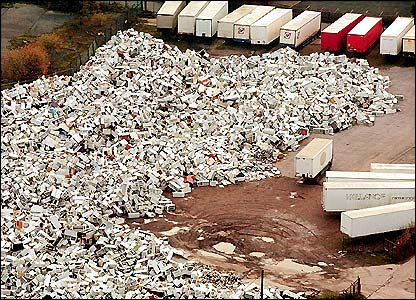
A portion of the Manchester fridge mountain!
You can plainly see the care in which these units have been treated, yes, with none at all! They’ve just been dumped. There appears to have been no attempt to reclaim, recycle or recondition any of them and, in the condition they appear to be in, there’s little hope of saving any at all.
In addition to that, form this picture, many will have their systems ruptured exposing the atmosphere to any gas left in them and the compressor oil will be leaking into the ground. It is quite disgusting really.
Over the past year UK Whitegoods has not toed the politically correct path on most occasions and this is not one of the occasions we shall either.
You Have Seen a Glimpse Of The Future
This is probably going to become a more common sight as time goes on and not just with fridges either. Over-priced spares, many costing more than a replacement appliance or the actual appliance cost in the first place to buy are all too common these days, too common in many a repairer’s opinion.
In January 2005 the WEEE Directive comes into Law and will be enforced later in 2005/6, most manufacturers have little or any provision for dealing with the directive. They have no way to deal with the waste that is produced.
Also many manufacturers are competing in the marketplace on price alone, so therefore the cheaper to produce the appliance the cheaper it is in the shops. Interestingly from the latest survey run on UK Whitegoods it would appear that consumers are prepared to pay more for a more reliable and longer lasting appliance, but it begs the question, if that’s the case then why do people still buy the cheapest that will “do the job”?
The next time you go to purchase an appliance ask the salesperson the expected lifespan of the product, ask for it in the literature. Ask for the failure rates of the appliance and who makes it, where it is actually produced and I’d bet that not many could answer those questions alone never mind some serious ones, like what the “end-of-life” process is!
As consumers you need to vote with your feet I’m afraid and tell manufacturers that you won’t accept that a module or motor costs more that 25% of the cost of the machien as we all know it doesn’t. Tell them you won’t be buying their products again and stick by it.
If you want more information or want to know who produces which brands just ask on UK Whitegoods or browse the site as there’s loads of information on here. As just because you buy a German name, much like a Mercedes these days, doesn’t mean to say that you are buying German quality engineering but you may well have bought a nice badge and both major UK names Hotpoint and Hoover are both now owned by Italian companies, most of the products are not produced in the UK.