
Refrigeration In Low Ambient
The short answer is you can’t install refrigeration to unheated areas, for more in-depth and why read on
 The first thing that you have to realise before deciding to buy a new refrigerator, freezer or fridge freezer is that they are not all equal, there are different rated appliances for different climates. Your first thought on being told this is perhaps that there are different ratings for say, the tropics, than there is for Northern Europe and, you’d be correct but there’s a lot more to it than just that.
So the first thing to check for after you decide which appliance you need is what we refer to as the “Climate Class Rating” which determines in what ambient temperature range (the surrounding air or room temperature) that you can safely run the machine in.
These are extremely important if you are not keeping the machine is a normal room in your home with a normal 18-22°C room temperature, deviating from that can cause serious problems.
They are not designed to be in very cold or warm environments, full stop despite many people seeming to think that they can put a fridge, freezer or fridge freezer wherever and it won’t matter.
When they are in an unsuitable place, they will not perform as they should and be more expensive to run (a lot in some cases), can be a fire and/or shock hazard and can have other “issues”.
This article applies to all of the following:
- Fridges
- Freezers
- Chest freezers
- Fridge freezers
- American fridge freezers
- Wine coolers
Beer Fridge
The other reason this topic comes up a lot is that people will put an old fridge or fridge freezer out into the garage to act as a beer fridge or additional fridge space.
Then, when it stops working in the winter wonder why.
Or, it starts leaking water in the summer. Or, just cuts out as the compressor overheats since it’s working way too hard and chucks it.
If this is down to the environment that the machine is installed in, there’s nothing anyone can do to help. Other than perhaps moving it back to a more suitable location if it’s not wrecked by that point of course.
Understanding Fridges And Freezers
To be as basic as possible a refrigerator is designed to do three things:
- Cool the air within it’s walls using a basic heat exchange system
- Keep that cool air inside the refrigerated zone for as long as possible to minimise energy use
- Keep out the warm air surrounding the unit
Now, there are two basic enemies that will stop a fridge from working correctly. The system that cools the air fails in some way or there is some sort of problem that prevents it from keeping things cool due to its environment allowing the hot air in or cold air out. System failure is a whole subject to itself and not within the scope of this article, we’re looking at the other reasons for it not working.
One of the factors that will determine how hot or cold an ambient temperature that any unit can be placed in is the quality and thickness of the insulation used to isolate the cool inside area from the warmer outside air. In short, the better the insulation the more expensive the appliance as a general rule and, ultimately, this will have a direct correlation in our experience as to how long the unit will likely last, especially in inhospitable environments.
Fridge & Freezer Climate Classes
These are the European climate classes for domestic refrigeration units:
N (Normal) Class = +16°C to +32°C ambient room temperature
SN (Sub Normal) Class = +10°C to +32°C ambient room temperature
ST (Sub Tropical) Class = +18°C to +38°C ambient room temperature
T (Tropical) Class = +18°C to +43°C ambient room temperature
As you can clearly see there is no rating that would allow normal operation below 10°C in any circumstance
Fridges & Freezers In A Garage Or Conservatory
This leads us to the problem and the reason for writing this article in the first place. Putting a modern fridge or fridge freezer in a garage or outhouse/outbuilding that is unheated is pretty much a non-starter and you are asking for trouble by doing so.
Likewise if, like some people we have come across, you keep your home, kitchen or utility area where the machine is, below 16°C then you may well also have problems.
With fridge freezers where there is only a single compressor (easy to spot as there’s only one black “bottle” at the back and/or generally only one control for fridge and freezer), this means that all too often the ambient can be lower than the cut in point for the fridge. Since the fridge thermostat controls the on/off for the freezer as well it means that, for long periods during the colder winter months, the freezer won’t cut in and the food will defrost.
The problem for the service engineer of course is that there is no fault with the appliance, it simply has not been installed in the correct environment.
Conversely, in an environment that is too warm, such as a conservatory during the warm summer months, the compressor can be working overtime trying to keep the insides cold enough. This is because the insulation isn’t designed to cope with the extremely high temperature and the unit cannot repel enough heat ingress or Keep the cold air in well enough, this can and does lead to many an early failure.
In the end, most refrigeration products you can buy easily are not designed for these environments and, if you place them under such conditions you should not be surprised when they do not perform correctly.
Freezers
Chest freezers in cold environments tend to form condensation on the outer skin due to the temperature differential and the insulation not being designed to cope with it. This forms droplets that run to the base where it drips off and pools or is soaked up by the insulation itself as the base of these machines are most often pretty open. Once water ingresses into the insulation the machine is effectively written off as repairs to insulation are, at best, difficult and cannot be guaranteed to work with 100% certainty.
Should you have a leaking freezer in a cold room, or indeed one that is too warm, then this is almost certainly the cause and again, there is no cure for the problem other than to move the machine to a heated room, or heat the room accordingly.
Anti-Condensate Line
On most refrigeration there is a “hot pipe” that runs around the door aperture of the machine, this applies to most refrigerators, fridge freezers and freezers, that is designed to heat any excess condensation helping it to evaporate away.
To see condensation around the door, or to feel heat there, is not unusual and is part of the normal operation of the unit.
Leaking Fridges & Freezers
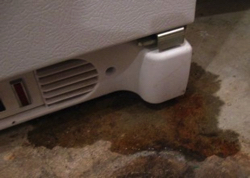 What you will often find, when there’s a report of a leaking fridge, freezer or fridge freezer and especially so in the dead or winter or height of summer is that the leak is being caused by moisture from the anti-condensate line.
As the machine struggles to operate and maintain the temperature in the cabinet it sort of goes a bit mad as, it really can’t cope. So the run times extend and, yes that will cost you a lot more in electricity, especially in summer and there’s a lot more moisture that forms where the anti-condensate runs round the door/s.
That moisture runs down with gravity and, viola, a leak.
A leak with no obvious or apparent cause to most people so it’s usually thought to be a fault when all it really is would be an installation issue.
This is a condensation issue but, it can get worse still.
Condensation Dangers
The problem with condensation on the outside of the unit, which is where it will form as hot air meets a colder surface, is that it can cause rust to form on the outer cabinet or shell.
Although this is unsightly it’s normally not that dangerous as such, immediately at least. Over time though it’s going to wreck your appliance.
The bigger danger is that moisture gets into the insulation.
If that happens, game over. Your machine is toast.
Worse, even if the machine is under warranty the chances are any manufacturer will walk away as it is not a manufacturing defect, it’s solely down to improper installation.
Don’t Do It
Our advice, knowing the technical issues and the often poor quality of many modern refrigeration products that are in no way designed for this sort of environment is not to install them in places where they are not meant to be.
It really is not worth the hassle if it goes wrong.
Or, you accept that it’s a case of “on your own head be it” and take your chances.
Our 12 year old Hotpoint Mistral Frost free fridge freezer has really struggled in the current heatwave and keeps shutting down. We live in an old house with poor air circulation in the kitchen and the fridge has to fit into a space its own size.Most fridges are designed to work in an ambient temperature of just over 30 degrees or so and I suspect that temperatures have persistently gone above that behind and under our fridge.Can you point me in the direction of any frost free fridge freezers that are better at coping with the sorts of temperatures we sometimes get in our summer (and which must be more common on the continent). Can we do anything to improve things with any of the standard fridge freezers (e.g. would it make sense to install some sort of fan behind where the fridge sits that might be used when temperatures get too high).
It is obvious why a combined Fridge-Freezer with a single compressor will not work properly in very cold conditions, but you have not properly explained why a stand-alone Freezer would not work in very cold conditions. You say that the insulation is not designed to cope with the temperature differential, but this is rubbish since the temperature differential will be lower in colder temperatures, so the insulation would have less work to do!
[quote name=”Dave22″]It is obvious why a combined Fridge-Freezer with a single compressor will not work properly in very cold conditions, but you have not properly explained why a stand-alone Freezer would not work in very cold conditions. You say that the insulation is not designed to cope with the temperature differential, but this is rubbish since the temperature differential will be lower in colder temperatures, so the insulation would have less work to do![/quote]
It’s not “rubbish” as you suggest. The thermostat will not kick in if the room temperature at which it is set to work is not met. In other words it’s preset at 10c and if your unheated room is 9c the appliance wont work. Similarly if the room remperature is above 43c (the thermostat upper temperature) it wont work either.
Hi Dave,The insulation gets wet due to condensation and fails, especially so around the condensate line. Asides from which you get condensation forming on electrics and electronics causing errors if not failures.In essence they are not designed for use in low temperatures or in humid conditions, period.So, it isn’t rubbish at all but I suspect that you’ve read it slightly out of context and, to be fair, it could be worded better.
Hi, I recently bought a BEKO upright freezer that is advertised as \’suitable for use in a garage or unheated room\’ but I find that there is varying amounts of condensation now forming on the sides and door. The amount varies according to the weather conditions. I am now in discussion with their customer service department who insist that there is no defect in the appliance but will send an engineer out to inspect it provided I pay for the visit if he finds nothing wrong.
I would welcome your advice.
We have mentioned on this site that, despite claims that some machines can be used in unheated conditions that they still conform to the climate classes as shown above and that running them at ambient temperatures below 10˚C is dicey at best.
What you have there is classic condensation from the condensate line and they will not be able to cure it. It\’s caused by the hot line that runs around the door and stops moisture forming on the seal in normal conditions.
In cold and/or damp conditions it can create too much condensation and you get exactly what you describe.
There is no cure other than to move the unit to a warmer location.
I had bosch fridge /freezer which lives in out buildings all it\’s life with no problem. Occasionally it stops chilling, so switch it off for 48 hrs. And works fine
So if you can\’t run a fridge freezer at temperatures below 10°C, does that mean you can\’t buy one if you ever go on holiday in the winter? I\’m usually away from home visiting famly for about 10 days Christmas to New Year and don\’t really want to pay to heat the house all that time.
My house has no central heating but a log fire in one room & stove in the main room. The kitchen/utility is just off the main room. Mostly a little warmth from the stove gets in there but recently we\’ve been having negative Celsius temperatures especially at night where it dropped to negative 9 last night.
I stoke up the stove constantly but it\’s a bit chilly in the kitchen/utility. Then tonight I noticed my fridge freezer, a Beko not working. Checked the frozen food and it\’s all still pretty hard except for some bread rolls which were\’t as hard as they should\’ve been. It\’s my guess it\’s only switched itself off during the day today. (a few hours)
I put a fan heater in there and within 10 minutes everything started humming again (i.e. working)
I know if I take that away the freezer will switch off again, and can\’t leave a fan heater on all night while I\’m asleep….
So what to do for tonight I have no idea.
But I think the solution has to be get a little space heater in that utility room. Amazon sell tiny oil filled radiators for about £20 or so. I think that\’s going to be the best answer. Simple really.
But no help for tonight!
I have had a similar problem in the past when I put a fridge freezer in the garage. My solution was to replace it with a freezer specifically designed to work in a cold environment.
My freezer is a Beko and it has been going in the garage for several years without any bother. I understand, however, that you have to get a suitable model.
Currently I am in the process of moving and thought it would be useful to have a fridge as well. I was advised by the sales person that under certain conditions it would not work and there was a risk that the fridge would break down, which concurs with the advice given on this website. Purchase of a fridge would be at my own risk and using it as I intended would invalidate the guarantee
I Have an upright Freezer which is situated in the garage. We have the freezer for approximately 12 years and no problems until now. Just recently the electric has started to trip out. when I switch the freezer on again, it only lasts for about an hour. If I have to replace the freezer can you recommend one that will go in the garage as this is the only place I can Store it. Please reply asp as it is full of food
thanks
I think the only thing to do is install a small oil-filled radiator in whatever cold room you want your fridge freezer to be in.
That’s what I did in my utility room. I have it on low most of the time (except summer) and it hasn’t cost me a fortune in electricity bills, and only cost something like £24 on Amazon.
And I bought a room thermometer.
I turned up the heating on it during this snow we’re having. The temp. in there tonight is just above 11C. That is the best I can do but it seems to be hanging on and not switching off.
That I found was the best hassle-free solution.
I just discovered that my stuff In Freezer was defrosting! It’s my extra fridge In a store room building and yes it’s cold atm! So that must be it. It’s always had water,pooling though under the veg containers,summer or winter.
Think I’ll have to do what you have and get one of those heaters!
Just hope it starts working again!!
I don’t have heating in my house and the ambient temperatures get down to single figures in the winter (I wear lots of jumpers and coats with a woolly hat, so I am lovely and warm) but my fridge/freezer stops working. So I have placed a bedside lamp (without a shade of course) with a 75+ watt bulb quite close to where the thermostat is housed inside the fridge. So thermostat responds to the warmth generated by the bulb and works normally. .You may have to put a piece of furniture of the correct height by the side of the fridge and lay the lamp sideways at the back of the fridge or wherever the thermostat is, this works very well. And is a cheap option.
We have kept our freezer in the garage for about 10 years as we have little space for it in the kitchen . It does tend to ice up at certain times of year – I think its worse in warm weather – I’ve never noticed a problem in the winter. However as our children don’t live at home any more we want to replace it with a smaller one. I’ve seen a few online which say they are suitable for outbuildings; they offer Winterguard technology or state they can work at temperatures down to -10/-15C. What about the maximum temperature? Does that matter as much?
On the face of it, it may sound illogical, but…..
When I ran my Samsung American-style fridge in the garage (annexed to the house, no damp cars in there etc, lowest ambient temperature about 5C, and not over 25C in the summer) it used about 3.6kw/h per day, while in the house I now use only 1.9 kw/h per day – figure this !
“How do I know?” – I hear you ask…. I put an electricity meter between the socket & the plug.
Can anybody explain the physics please.
I assume it’s because the fluid the compressor pumps round gets thicker in the cold and it has a harder time moving it around. So it either uses more electricity or in the worst case burns out the pump.
I have a 20+ year Hotpoint freezer in a brick shed attached to my house.
It had a slight problem with condensation in one small spot on the top of it so I placed a polystyrene slab and a sheet of chipboard on top, sealed around with gaffer tape.
I[b][/b]t has never stopped working, needs defrosting in summer.
I now have a smart energy meter showing it consumes a lot of energy and Was considering replacing it.
I’ve been told the only fridges on the market in the UK that are suitable for outside buildings are made by BEKO.
No one I spoke to in any of the six shops I have visited could BEGIN to explain why some freezers can go outside while others can’t, they just said that I needed to buy a BEKO.
My shed goes down to 4*C in winter and up to 25*C in summer.
My old Hotpoint has worked for years, trouble free.
Excess energy consumption or not, it is STAYING!
This article states nothing works below 10C. What utter nonsense, spreading misinformation, shame on ukwhitegoods.co.uk. All Beko freezers for example work colder than that. My parents have one they bought recently in their garage, which gets to -10C regularly, and it worked fine at -19C one winter! The classes listed are clearly missing the cold one. There is more than N, SN, ST, and T.
Look on Beko’s website: https://www.beko.co.uk/appliances/refrigerators/freezers
“Place your freezer anywhere in your home
Whether you need to place your freezer in your garage, your outbuilding, or anywhere else in your home, our Freezer Guard technology ensures your freezer will always function properly, keeping your frozen food frozen whatever the outside temperature – even if it drops to as low as -15°C.”
You are right Beko do freezers that go down to -15 I had one delivered today to replace my chest freezer that has been in my outhouse for 18 years which worked fine. (Daughters having it now) I also had a fridge freezer which wasn’t beko and the freezer stopped working in the winter . I think all companies should do the freezer Guard, as a lot of people use outbuilding for them.