

Over the past day or so the Local Government Association (LGA) has expressed serious doubts over the implementation of the forthcoming WEEE Directive. The directive forces manufacturers and retailers of electrical and electronic goods to become responsible for the safe disposal of the good at the end of their lives and pay for the recycling of old machines.
The LGA has stated that the local authorities have been offered a one-off payment to deal with this waste of just £6500 per site, stating that this is a “drop in the ocean” in relation to the true costs of WEEE implementation and councils may refuse to deal with this waste without more funding to accommodate it.
“It’s a choice, councils don’t have to get involved in it,” said a spokesman for LGA, “Decisions will be made on a local level and if the cost is too much, they won’t do it.”
The LGA is warning that mountains of WEEE waste may appear, much like the fridge mountains a few years ago and that council tax payers may well have to end up footing the bill to clean up the mess.
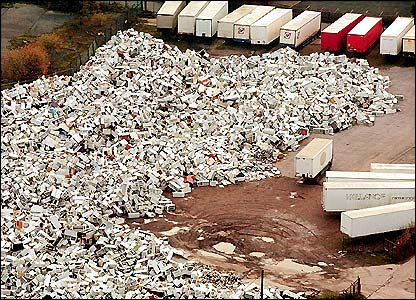
Cllr Paul Bettison, chairman of the LGA’s environment board, states, “It’s totally unacceptable that the council taxpayer should be expected to shoulder the burden for new schemes that businesses should be paying for.
“We risk a situation similar to that of the fridge mountains a few years ago unless more money is invested by business. Without councils’ involvement and their recycling centres there’s little chance of the new system working.
“The memory of thousands of fridges piling up from a few years ago is still fresh in many people’s minds. From July next year, a whole range of electrical appliances will need to be recycled in a similar way.
“The fear is that unless councils are fully involved we could be risking a situation where hundreds of thousands of TVs, mobile phones and kettles end up being piled high once again.
“Not only would this be an eyesore, the environmental impact could be deeply worrying too. Electrical goods often contain poisonous substances, such as lead, which can contaminate drinking water and mercury which can cause damage to the brain.
“Councils are on the frontline in the fight against climate change and it makes perfect sense for businesses to make use of existing refuse and recycling centres around the country. Local authorities have the experience, expertise and resources. However, councils won’t take part if they have to foot the bill. The law makes clear that it must be the producer that pays.”
We can’t understand why the WEEE Directive seems to be solely directed at combating the aftermath of a throw-away society fueled by cheap appliances and not addressing the core issue of why we need to replace these goods so frequently. We recently published an article that clearly shows that the average age at which washing machines has dramatically fallen in recent years which you can read from this link
It seems only sensible that the best course for the environment is to avoid replacing these machines, avoiding the waste in the first place. This can be done easily by making replacement parts and repairs more economical and available.
Already it has been shown by some more forward thinking and environmentally orientated manufacturers, such as ISE, that making products last longer and affordable to repair instead of replace is a far more environmentally friendly way to tackle the problem of waste. This attacks the culture of throwing goods away too early instead of the effect of a shortened life.