

Overloading
Just as much as people overload washing machines, tumble dryers also get overloaded on a regular basis and it causes issues with the efficiency of your dryer as well as potential failures.
Often people seem to be tempted to squeeze in as much as possible to dry as much as they can on one load or, do this with the misconception that drying more in one load will save them electricity and money. Largely, that isn’t true but you also run the risk of breaking your tumble dryer if you stuff too much into it.
Of course the people that repair them are happy if you do but, we’d rather you didn’t. Or more accurately, we’d rather not to have to tell you that you have and that’s why your tumble dryer is broken.
A good proportion of the faults we see are down to people not using appliances correctly, if you take the time to read through this article and others, we hope you’re not one of them.
How Much You Can Put In Your Tumble Dryer
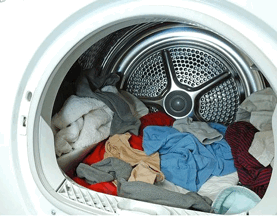 Roughly, you can fill the drum of your tumble dryer about half full, perhaps slightly more but not too much.
The reason is that in order to work air has to be able to flow through and around the laundry in the drum freely and the laundry to be able to move about.
If the laundry cannot move or the airflow restricted then the dryer will be operating far less efficiently and this will cost you more in electricity asides from running the risk of breaking your tumble dryer.
Tumble dryers are all about airflow, if airflow is restricted or impeded in any way then you will be running up electricity bills like there’s no tomorrow because the dryer will be running hugely inefficiently. This is why regular maintenance of filters and condensers on condenser tumble dryers isn’t just important but, absolutely vital.
This is why load capacities on dryers are usually much less than they are on washing machines, even from the same brand or manufacturer and even in the same range or machines. The fact is that to dry laundry effectively, a lot more free space is required in the drum.
Faults Overloading Can Cause
Overloading your tumble dryer can cause a myriad of problems with it from failures that can just be irritating or inconvenient to major problems with your dryer. When we look at tumble dryers from a field service perspective many of these failures are usually relatively easy to spot and determine what caused them in all probability.
Keep in mind that no manufacturer, where they detect misuse, will cover these kinds of failures under warranty so please don’t be complacent and think you don’t have to take care because your dryer is under warranty.
Thermostat Faults Due To Overloading
The most common failure on most tumble dryers is thermostat failure, usually the overheat thermostat or, TOC as we refer to them which stands for Thermal-Overload-Cutout.
These small thermostats are a safety device that operate when the tumble dryer overheats, the will usually go open circuit and stop your tumble dryer from heating. Of course they can activate for a number of reasons but one of the favourites is that the airflow in your dryer has been reduced causing heat to build up and the thermostat to operate.
Overloading is one of the primary causes of this although there can be other reasons, more of which we explore in a full article about tumble dryer thermostats.
Belt Failure Due To Overloading
We have explored this in greater depth in its own article about tumble dryer belts snapping but, in short, overloading is probably the most common reason for a belt to fail in a tumble dryer.
For us the problem is that the reason is blindingly obvious, the dryer was overloaded or the load too heavy.
Without another component failed, such as a support wheel or runner, this is the only possible explanation.
Fire Risks Due To Overloading
There is of course a real fire risk if you overload your tumble dryer.
It’s common sense really, there’s an element at the back of the tumble dryer and if the load cannot move away from the area that heat is blown into the tumble dryer then the laundry being forced there by the load will just heat and heat. Aside from the fact that this can be a cause of clothing damage it is also a potential fire risk, just as much as not maintaing the filters and so on.
Weight Versus Volume
As with washing machines often we will see, especially in warranty when the fault is not covered due to it being an overloading issue, people claiming that they haven’t exceeded the maximum weight allowed according to the specification.
This is a maximum for the weight only!
The fact is that both the weight and the volume come into play and if you ram pack the drum full, regardless of the weight, the machine is overloaded.
It is our opinion that the weight is actually a poor measurement due to this and other factors for loading washing machines and tumble dryers. To rely on this one factor would be a folly.
It is good for marketing purposes when manufacturers declare the “biggest” but, in daily use, it’s not really very useful.
Too heavy a load will normally only apply when people either overfill their tumble dryer or, they cram too much into it but if you put in items that are still either very wet or even sopping wet, then it is very easy to put too much weight into the dryer.
hi do you know what DOP means on the display please, have looked everywhere and cant find an answer anywhere