

In the past, we have had times when people don’t quite get the difference between what “power” and “energy” are, as it can be a bit confusing when people who deal with this sort of stuff (like us!) often fail to explain well.
We thought it might be a good thing to offer a better explanation, and then we came across this video from Technology Connections that, while a long video, is very much worth spending the time watching as it brilliantly explains the difference between the meaning of power and energy.
{source}<iframe width=”560″ height=”315″ src=”https://www.youtube.com/embed/OOK5xkFijPc?si=zHwdPAjbQBkZcx8S” title=”YouTube video player” frameborder=”0″ allow=”accelerometer; autoplay; clipboard-write; encrypted-media; gyroscope; picture-in-picture; web-share” referrerpolicy=”strict-origin-when-cross-origin” allowfullscreen></iframe>{/source}
Applied To Repairs
When we talk about power in respect to repairing appliances, components, and so on, you will normally see things like “Is it getting power” being used and what this means is the component in question is getting a power feed.
You see, for repairs, we are not really all that interested in the energy being used as that is for operational purposes when repairing is largely ignored, it’s only on very rare occasions that any repairer will have to even know about this, let alone answer a question or deal with fault related to it.
For the machine to operate, all we need to do is ensure that the appliance is getting power and then that the components required to operate at a given point get the power that they need to do so. How much energy that they use is largely irrelevant for repairs.
Applied To Buying Appliances
This is where things get way more interesting and where you can go down a plethora of rabbit holes.
If you watched the video (of course you did, we’re assuming), then you should take note of several things but the standout one is that how much energy will be used depends on how you use the appliance. Your use, how you use it, what’s in it, and so on will vary wildly from one person to another.
This is very important as when we offer advice on any appliance, we can tell you what we think in general terms. However, we can’t offer you a cast-iron, gold-clad guarantee that what you do will get the results we’d expect in every instance. However, we will be largely correct in general terms.
Results can also vary depending on the installation circumstances in some cases as well.
In short, there are variables, and we can’t account for all of them. And the results that each home gets can vary quite a bit
How Much Juice Will it Use?
And all this is what makes this question very hard to answer, nigh on impossible in fact.
People see energy ratings and often almost take them as gospel as it were that, for example, an A+ is better than a B-rated product and whilst in ideal circumstances that may be true, it doesn’t always pan out that way.
We’ve published several articles about this over the years. You can find in the buying advice section that explains why this might be, depending on your use case.
As a real-world example, have a look at this:
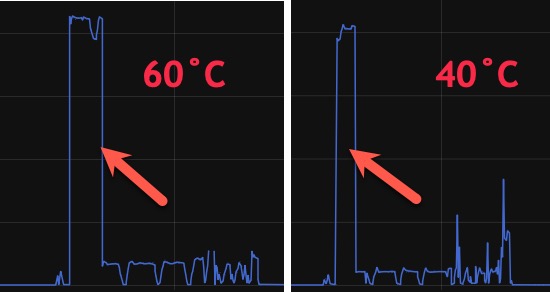
On the left is an Asko-made washing machine running a 60˚C cycle with a full load of towels in it, and on the right is the same machine washing a full mixed load at 40˚C.
You can see that, apart from some minor variances, the only big change is where the red arrow is, that’s the machine heating, and it’s obvious that the machine is drawing power, roughly the same power draw, just for longer on the warmer cycle. So, the warmer cycle clearly shows that more energy is being used.
But those could change, not wildly dramatically, but change nonetheless, mostly depending on how much load is in the machine and the temperature of the incoming water. For example, if the inbound water is 10˚C in summer as opposed to 2˚C in winter, that’d make a huge difference to both, but relatively.
The load size, absorbability, and so on, you can’t account for, and whilst it won’t be as massive a difference, it still will affect the energy used.
This is why we will often tell people when they are concerned about energy use and the cost of it that it’s almost impossible to predict how much energy and therefore, the cost of running, any particular appliance might be.
It’s also one of the reasons why we don’t put too much stock in the energy labels.
Repairs & Energy Use
There have been instances, as some people do measure this and with the proliferation of smart homes, apps reporting energy use, and so on, that a good number of people watch this stuff and some fret about it.
The simple rule of thumb is that if the machine is working and performing as it should, washing, cooking, cooling, etc., then it’s very, very unlikely there’s any kind of fault unless the energy use is massively out.
But you need to watch out for stuff like seasonal variation in energy use, in winter, many appliances will use more to overcome the environmental conditions, such as dryers in outdoor or cold places, they will use a lot more energy to overcome the low ambient temperature. Refrigeration is installed next to heat sources, even ovens or cookers. Water temperatures and so on. It’s largely common sense stuff, although not always obvious to everyone, especially those who believe that the energy used will never vary.
As we said above, there are a lot of variables in this and there’s no “one-size-fits-all” here.