

Smelly Washing Machine
What causes smelly washing machines, the solutions and how to stop it from stinking
TL;DR
- Almost always a result of low temperature washes with non-bleach containing detergents, leading to a buildup of biofilm
- You need to wash at the correct temperatures
- Proper detergent must be used for the laundry and the program
- Maintenance washes are essential
This is a pretty common thing that we service guys encounter, people complain of a bad odour from the washing machine or washer dryer.
 First, let’s start with a simple fact: no component can fail to cause a bad odour from inside a washer. Sorry, but it’s not a fault with the machine, and it will undoubtedly be from some form of external source and in this article, we will explain what causes the problem, how to solve it and how to avoid bad smells from your washing machine.
The major factors that can cause the problem are explained here, and we ask that you please read this article thoroughly and check as much as you can before calling any service department. If you have a smelly washing machine, please follow the instructions here in full, and it should help you solve the problem and prevent it again.
It’s also been brought to our attention that there are several people out there, along with some companies, that are giving staggeringly bad advice on how to deal with this problem, mostly to try to get you to buy some product like a washing machine cleaner, most of which are targeted at dealing with limescale, not odour issues. The advice given in this article is correct, and we will explain how you can try to resolve the problem for free if you want or use a commercial product that will solve the problem properly.
Low Temperature Washes & Plastic Tubs
 Consistent low temperature washes without a maintenance wash will very often result in a buildup of bacteria inside the drum if you combine this with liquid detergent (more on this below) then it is an almost perfect recipe for bacteria buildup inside the drum of your washing machine.
This never used to be a problem on older washing machines, and although we can’t prove it absolutely, we are sure know why.
As washing machines have gotten cheaper and cheaper to save on production costs, manufacturers have moved away from using enamelled and stainless steel tubs (the big drum around the one you put clothes in, which holds the water) and moved almost entirely to using plastic ones. There are no low-cost washing machines now that do not have a plastic outer tank that we know of, and by that we mean any under about £700.
The plastic tanks have nooks and crannies that can harbour bacterial growth, as that’s the way that they are designed, and the surface isn’t as smooth as steel or enamel, allowing bacteria to take hold and breed. You can see the same effect on plastic cookware, tubs and so on, where, if you store things such as chilli or such, the plastic discolours, only it’s not discolouration, it’s residues on the plastic surface.
This builds up, creating what’s known as a “biofilm”, which is a coating of bacterial sludge on the outer tank’s inner wall, which leads to a bad smell. In extreme cases, we’ve seen this to be a centimetre or more thick, and it’s disgusting and smells disgusting as well.
In extreme cases, you can get lumps of mould coming out in the wash or small black marks, speckles, etc., on clothing. Yes, in you’ve case, not sussed it yet, there are lots and lots of people out there that are washing their clothes in bacteria, and then we wonder why we have skin irritation problems.
And, whilst we don’t profess to be scientists or experts in that field, would we, or you, be surprised if skin irritation was being caused by this? It is, to our minds, far, far more likely that something like this is the cause of that problem rather than detergents that have to jump through all manner of testing to be made fit for sale.
You can read more about mould and mildew in this article.
Liquid Detergent Can Make It Smell Worse
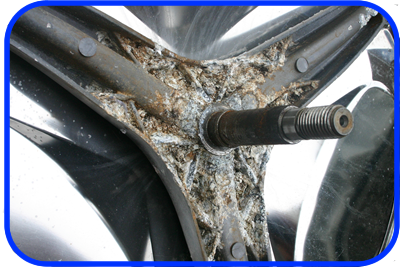 If you use liquid detergents or liquid capsules, then this is most likely the problem or a good proportion of the cause as there is no chlorine bleaching agents in liquid powder, and it has a tendency to smell a bit ripe after a while. It is also VERY easy and prone to over-dosing, which can lead to a congealed mass of goo in, or on, the drum, which, in extreme cases, can actually corrode the aluminium drum shaft.
Shown in the photograph to the right is a badly corroded alloy drum support spider from just such treatment and this is, by far, not the worst that we’ve seen. In some really bad cases, the support almost disintegrates.
Sorry, soap powder manufacturers, but we see this in the field after several years.
The cure is to use powder (real stuff from a big box) and wash through a boil or hot wash with the machine empty, this is known as a washing machine maintenance wash. Or you can cheat and use dishwasher cleaner or bicarbonate of soda, both are effective at cleaning this but not as good as a dedicated cleaner like Affresh or Power Fresh, which is rebranded Affresh.
Ariel tablets are also okay as they dissolve just as fast as powder and can be used in the drawer, unlike other soap tablets.
Using soap nuts or ecoballs is just a disaster waiting to happen as well as both will increase the likelihood of you having a problem in the first place massively.
Backfilling From The House Waste
Often, we will see appliances incorrectly installed, allowing dirty water from your drain to come back into the appliance. If you see the appliance slowly filling when it’s switched off, it is almost certain that this is the problem and you will need a plumber and not an appliance engineer.
You can also try the cleaning tip as detailed above, but it will not stop the problem from recurring at some stage.
More information on backfilling from this link
Washing Machine Maintenance Cleaning
When this article was originally published about a decade ago, the only option we had to recommend as a maintenance wash was to do a full “boil” wash program (as hot as you can get basically) with a bleach-containing detergent. The best option there that we would recommend is using Ariel (from the green packs) as it also contains components that deal with limescale and many other bits of dirt that you don’t want there, or Persil Bio. We know that Ariel or Persil is a little more expensive than some, but both are a lot better in our opinion, and our testing bears that out.
A good alternative we’ve found, that’s a lot cheaper, is Aldi’s own brand detergents; they are very good and not so expensive.
 Doing this regularly, once a month or so, can stop the problem from occurring in the first place and is recommended by most service engineers, as well as others within the industry and is often detailed in the manufacturer’s instructions.
Also, make sure that you clean out the soap box thoroughly, all of them come out somehow, and it’s usually in the instruction book how you do this. Pay particular attention to the softener section (if you use it) and make sure that bit is cleaned regularly or you can get a build-up of not very nice gunk as well as possible leaks from there.
If you get the soap drawer out and look up above it you’ll see a series of jets, this is where the water comes in to disperse into the drawer, make sure that is also clean, we find it best to use an old toothbrush dipped in a little bleach to get them clean, especially if they are a bit mouldy. Any black “stuff” you see in there is mould, it’s a buildup of bacteria that just love the wet environment to breed in. it is best to do this before a maintenance wash to ensure that any bleach or other cleaning products are removed and do not then affect the next load that you wash.
You can find out how to do this on most washing machines from our article about how to do a maintenance wash for your washer.
Drying out can also help massively; this is why many people advise that the door of the machine is left slightly ajar. If you are having problems with mould or an odour, doing this, whilst unpleasant at first, will help in the long term with the above advice.
A Cleaner To Solve Smelly Washing Machines
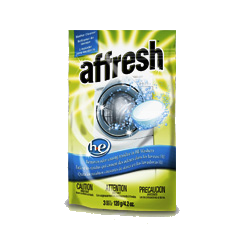 This article was originally posted in 2004, and since then, we’ve been searching for a cleaner that can solve this odour problem for people. In 2008, we finally found one that actually worked, properly!
Affresh washing machine cleaner has been specifically developed to combat the problem of smelly or foul-smelling washing machines and is available in the online store along with it’s sister product Affresh Dishwasher Cleaner.
In short, Affresh attacks the residue itself, breaking it up and sending it down the drain and, regular use can stop it from happening again. The great thing about this is that it’s not stupidly expensive either; it’s actually quite cheap.
We get asked all the time on the best way to solve the problem and, especially if it is fairly bad, maintenance washes can take a long time to clear the odours but it still won’t remove all the scum that’s left, Affresh will as it is specifically designed to break these residues up.
If your machine is really bad, you may have to use a full pack on the first pass and possibly need to re-treat again, perhaps even a few times, depending on the severity of the bacteria buildup. And, it could get worse before it gets better!
The reason is that each time you use Affresh or a maintenance wash, it “peels off” the top layer of bacteria, leaving more stinky gunk exposed than before, which makes the smell work. There’s no solution other than to persevere and repeat until it clears, which, in some really bad cases we’ve seen, has taken more than a dozen washes!
Most other washing machine cleaners that we have come across, often sold in supermarkets and the like, are not as effective as Affresh and tend to merely mask the smell from the gunk in the washing machine, not solve the underlying problem. But then, they are much cheaper in some cases.
Bad Cleaners
Okay, so here’s the problem now since the whole smelly washing machine problem became a thing.
There are a bunch of companies, including global ones, that are trying to cash in on it by launching a ton of rebranded products to “solve” the problem. Some are okay, others are just rubbish, and some are just descaling products that have been rebranded as cleaners.
Some of them will mask the smell, some might even do a little bit of actual cleaning, but how well is open to question.
For people who don’t know much about this stuff, it’s confusing.
Worse still, you can end up buying a product that you think will cure the problem, as that’s what you’re being told, but that isn’t going to do what you need. Some might even look like a bit of a bargain; however, it’s not a bargain if it doesn’t work!
Please follow our advice, if it’s bad and a maintenance wash doesn’t clear it, use Affresh and that in conjunction with maintenance washes, will eventually solve it.
We know this stuff well, and we know that some of the stuff that is sold as a washing machine cleaner is garbage. The reason there are so many doing it is that the cheap stuff that can be flung together on the cheap is profitable, and we could sell that junk too if we wanted.
More Information About Smelly Washing Machines
You can find more, as well as related, information on the effects of not carrying out a maintenance wash from the following articles:
Washing Machine Health Concerns
All about biofilms, health concerns, black marksm corrosion and more.
Door Seal Mildew Or Black Marks
Why you can get black mould and what to do when you do, as well as tips to avoid it
How to clean the soap drawer in your washing machine to avoid smells and bacterial buildup
Whiter Whites, Brighter Colours
How to use detergents correctly.
Washing Machines, Detergent & Skin Irritation
Does detergent really cause skin irritation or is there more to it?
Is this problem a public health crisis news article
From “The Art Of Laundry” issued by Procter & Gamble: 
Appearance
On occasions, there can be a buildup of residue on the inside of the washing machine, which may transfer to garments. The deposits can be caused by dirt, grease, lint or hard water salts. Unpleasant odours may also arise from the residues. Higher temperature washes and bleach containing detergents can help prevent these residues.
Treatment
Do a “maintenance wash” (hot wash of at least 60°C or above with no load in the machine) using a heavy-duty bleach containing detergent such as Ariel powder or tablets. In extreme cases, more than one maintenance wash may be needed.
CAUSE: Insufficient detergent is used regularly, so dirt is not properly dealt with
PREVENTION: Always use the recommended amount of detergent appropriate to the amount of dirt, water hardness and load size
CAUSE: Detergents without bleach are consistently used
PREVENTION: Carry out a monthly maintenance wash using a bleach-containing detergent such as Ariel powder or tablets
CAUSE: The washing machine is consistently being operated at lower temperatures
PREVENTION: Carry out a monthly maintenance wash using a bleach containing detergent such as Ariel powder, tablets or use Affresh to clean the inside of your washing machine
CAUSE: The washing machine has not been given basic maintenance
PREVENTION: After using the washing machine, wipe around the door seal leaving the door open after use.
The expense of having to do a boil wash every month would now put having a cheap washing machine in the expensive class. It would be cheaper to buy an expensive machine with a metal drum.
😆 Great info and advice thank you will try.
very helpful, will try the recommendations, thanks
Exactly.
Great advice all makes sense, will try these suggestions, thanks
Our old AEG machine washes fine, but after a while towels came out smelling a bit soapy and unclean, though they looked fine.I happened to be fitting a domestic water softener at the time, and afterwards the smells had gone, only to reappear about 3 months later. This being an old water softener, it needed regenerating (which uses salt) about every 3 months. After regenerating, the smells had gone again.My deduction is that the smells were from soap residue remaining in the clothes after the main wash. Our hard water had turned it into scum during the rinse cycle, so it stuck to the fabric. Soft water stopped this, so the rinse cycles successfully removed the soap residue, and hence the smells.
Hi I’am a kitchen fitter and get asked this question all the time and it’s nice to get on a site that can answer the question, often said it’s the combination of liquid balls and comfort nice to here I was on the right lines. Top site.
Great information, and free, thanks for that. The smell from our washer and the build up of that stagnant smelling water inside knocks us sick. Will use the tips on here to defeat the stench. Much appreciated, you should get a medal or something for this service.
Thanks for the advice it was most helpful, i will try the suggestions stated.
i advise my customers to soak overnight,2 cups of bleach, add to machine, run machine to fill with water and switch off. leave overnight and drain. first wash may be affected by the leftover bleach so take care.
I’ve just dismantled a friend’s 6 year old clapped out Bosch machine (bearing gone!)to cannibalize it for parts to keep my own machine running.His wife clearly uses far too much pwder in her washes because the machine was thick with it. What really surprised me , though, was a massive build up of slime on the back of the drum and the tub where normal washing never reaches. I must have scraped off 2 pints of it before I gave up. I don’t know if service washing even would be of any use to get rid of this – a pressure washer would be the best way to deal with it because of all the crevices, but there’s no way to get in there to do it. Interestingly the slime was the same colour as her fabric softener. Never use the stuff myself – maybe that’s why my 12 year old machine is still going and my mates has clapped out. The softener is a wetting agent and will make it easier for water get past the seal in front of the bearing. Photos available if anyone wants one!
I’ve maintained my own 20 year old Zannussi including drum replacment. It’s still going very well. I had the smelly drum problem and cure it – is caused by ‘anearobic bacteria’ – the same kinds of bugs (bacteria) that live down your drains!! They don’t like OXYGEN – hence the name ‘anearobic’ – the cure is simple: LEAVE THE DOOR WELL AJAR WHEN THE MACHINE IS NOT BEING USED – this allows fresh air containing oxygen – yes, the stuff that we breath. It kills anearobic bacteria (bugs to the rest of us)- DEAD! the machine will stop smelling and so will your washing. It will help to do an initial hot wash cycle with a half cup full of bleach – NO CLOTHES, NO POWDER. JUST WATER AND BLEACH. This will kill the majority of the bacteria in one hit. They will come back though very quickly if you don’t follow the second bit of advice – leave the door well ajar to get OXYGEN in there. Good luck! Richard
[quote name=”jonfield”]i advise my customers to soak overnight,2 cups of bleach, add to machine, run machine to fill with water and switch off. leave overnight and drain. first wash may be affected by the leftover bleach so take care.[/quote]thanks for the info I will try it as I have tried all sorts of cleaners and nothing works
Thanks for the info I will try it as I have tried numerous cleaners and nothing seems to last.
does leaving bleach in the machine overnight not cause corrosion problems. It took the chrome off our sink fittings
[quote]This never used to be a problem on older washing machines[/quote]
Oh yes it was!
When I was a kid in the 1980s, we had a Hotpoint which had a Metal tub (I used to repair it after the 5yr warrantee, so I had the back off many times). It was one of the most expensive washing machines in the store (One Miele cost more).
When a liquid detergent first appeared in the supermarket I suggested we tried it (Radion I think), and some time after that, we started having problems with black marks on the laundry. My mum had the black door seal replaced I think 3 times as she blamed it for the black marks, I think the last one was grey, but the marks started appearing again and then we started noticing an awful stink. The machine was full of slime and mould and reeked to high heaven.
My mum used some 90C washes and chlorine bleach on it to clean it up. Going back to powder cured it for good.
The cause was liquid detergent and 50C washes.