
Over the years, across a number of articles, we have looked at and tried to address people’s concerns about smelly washing machines causing health problems, specifically skin irritation, and it’s a topic we’ve continued to investigate.
For a long time, we’ve seen people being advised, when they have a problem, to switch detergents, but we are 99.9% sure that’s not the problem.
Whilst we are not scientists in a lab with a barrage of test equipment, we have looked at work by others in the areas we will discuss as well as our own experiences across several decades and, we got to what we think, we’re pretty darned sure, is the root of all this stuff.
It isn’t a short story, though, and there are no quick, easy answers.
Back In the Day
When washing machines were starting to become more commonplace in most people’s homes, back in the 1970s and 80’s almost all, whether they were top or front loading, were largely made from metal. The tanks in them (that the drum is inside) were made from enamelled metal or stainless steel.
Back then, we think there were some reports of skin irritation and the like being linked to washing machines, but not a lot.
This is anecdotal obviously, as nobody seems to have any records going back that far and there aren’t a lot of people left who remember that period, but from what we can find out, it was never a particularly big problem.
Washing Machines Change
In the late 1980s, the first we can recall, Zanussi launched a new range of machines that used what they billed as Carboran for the main wash unit’s outer tank. Essentially, it was a fancy name for a plastic because saying you’d made a washing machine from plastic probably wasn’t a good marketing move.
There was a fanfare about how it could be recycled and reused (though no method to return the used ones was ever implemented to our knowledge) and how it was just “better” than what had gone before.
Slowly, other manufacturers also moved to plastic tanks and washing machines got cheaper in real terms. From all we can gather, the plastic tanks just made the machines cheaper to make, thereby making them more “available” to more people.
Top-end makers stuck with metal. Professional machines, stuck with metal.
Within a few years, in the mid to low-end machines, it was hard to find anything but plastic tanks and this is all too common a sight:
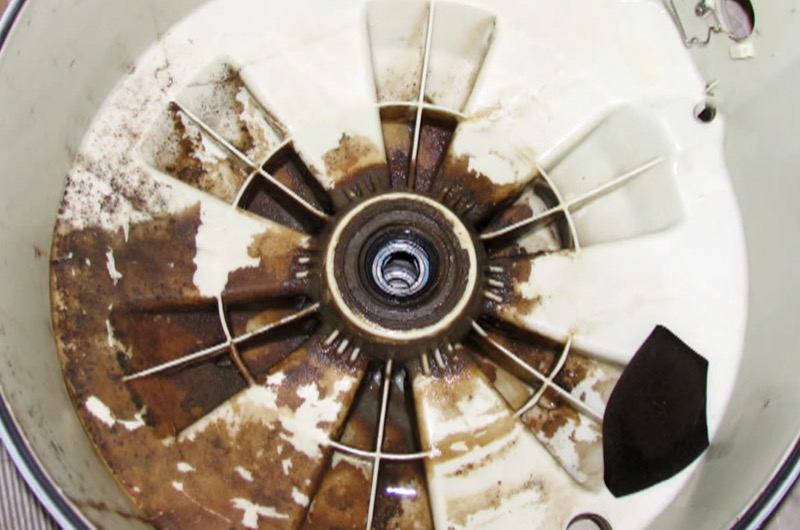
And that’s not a bad one!
Washing Habits & The Drive To Reduce Consumption
Not long after those changes were happening, in fact, to a degree, as that was happening, there was the whole thing about us destroying the world by burning things and using too much energy so, there was huge efforts put into addressing that.
Largely due to mandatory energy labelling we reckon.
This meant reducing wash temperatures, which, when it’s below 60˚C, will largely not kill bacteria at all, so below that temperature it’s not considered to be a sanitary wash. Not exactly a great move given the whole “cleaning” objective of a washing machine.
We got reduced water levels in order to reduce energy use because energy labels and all makers were chasing an A or better rating but that means longer wash times combined with lower temperatures.
All this is a recipe for an almost perfect environment for bacteria to grow and thrive, warm but not too warm, damp and new bacteria and germs coming in regularly from dirty laundry.
The Problem With Plastic
Apart from the obvious stuff about plastics being bad, we all know now, that we sure didn’t know 30 years ago, and what we found looking into all this was that plastic, whilst it appears to be smooth and many people would presume great at holding in water is, that’s not entirely correct.
Plastics all appear to have a knack for holding onto things. For example, if you put a tomato-based sauce in a plastic container, it leaves a reddish stain, we all know this and know that you need to clean it well with detergent, motion and pretty hot water, put it in the dishwasher (same thing) or bleach it to get it back to the way it was. This is pretty common knowledge for most people.
The same thing is happening in most washing machines. Just on a bigger scale and, with the stuff you put in it.
Microbes, germs, whatever are getting a hold on the plastic and sticking there.
Over time, they build up and form what is known as a “Biofilm” on the inside of your machine and, this is a big, big problem.
What’s A Biofilm?
A biofilm is as the name implies, a film that forms on a surface made up of something biological.
In this case, it’s made from bacteria that “grips” onto the inner surface of the plastic outer tank and builds up over time. How long this takes will vary wildly depending on how you use your machine, what you put in it, what programs you use and more. Meaning there is no one-size-fits-all answer to this.
Biofilms can grow on almost anything but in a lot of cases, cleaning will remove them or prevent them however, inside a washing machine, where it forms, you cannot reach it to physically remove the buildup without splitting the tank open. And, of course, in many modern machines, you can’t split the tank at all so if this problem gets really bad, the only option is a new tank unit or a replacement machine.
Once this starts in your machine though, there’s often no way to get rid of it entirely.
This is the part that led us to research this more, the lifecycle of a biofilm, that we found a great explanation of on The Centre For Biofilm Engineering at Montana State University in the USA.
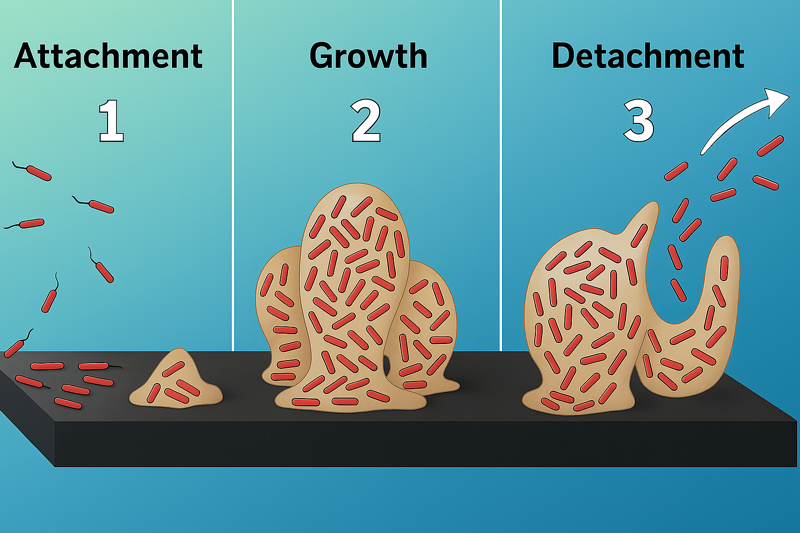
As you can see, once it takes hold, it grows and then ultimately starts to detach or, at least some of it does.
In a washing machine, those can really only redeposit onto the laundry in the machine or, be expelled in the drain but, we’d expect a lot to redeposit onto laundry.
And that, is a huge problem.
If that bacteria is redeposited onto laundry that people are wearing next to skin, we’d be astounded if it wasn’t causing skin irritation problems. It could even cause severe irritation we suspect as well as potentially give rise to other health concerns.
When you consider that many, if not most, people don’t correctly use detergents, programs or follow care labels, then factor in machines not hitting the temperatures that they should, it comes as no surprise that these films form.
Washing In Bacteria
What all this means is, there’s an awful lot of people washing their laundry in a smelly bacteriological soup!
Trying to combat that with cleaners, detergents and smelly stuff like conditioner (which probably only worsens the problem) to mask the underlying issue. And stink.
It will be plain that this is not hygienic at all and is very likely to cause health concerns if not outright issues, especially in respect of skin irritation where bacteria is redeposited onto “clean” laundry or perhaps even more worries such as those we’ve expressed in the past about healthcare sector workers washing their own uniforms etc.
It is a valid, potentially serious and real concern that should not be dismissed.
What we suspect is happening is that these biofilms are forming on outer tanks, just as the studies show, then breaking iff as shown to cause horrendous odours and redeposits on laundry, leading to issues of skin irritation and potentially the spread of infection or disease.
How serious it is, how much of a threat to health it is is hard to gauge for sure but, it does, from the comments we’ve gotten on the topic, seem to be on the rise. Albeit slowly.
Just think about i,t though, if you get a young family that is washing nappies or suchlike that are literally caked in bacteria, that could be getting redeposited onto your clothes, that you are wearin,g thinking they’re clean.
Gym, workout stuff that’s caked in sweat and skin grease, you get the pleasure of wearing again and again.
It’s not a pleasant thought and whilst a cheap washing machine might seem like a bargain as “they’re all the same and do the same thing” that simply is not true. Not true at all.
Dark Spots On Laundry
This is another thing we can’t “prove” beyond doubt but we’re pretty sure that we’re right. Some detergent makers may have researched this or, tested items and know this but we don’t have access to that information.
You’ll see on the biofilms that there are three basic stages: attachment, growth then detachment.
What we think is going on here, where people get dark spots, often described as being black, grey or brown, is that that’s just exactly what’s happening. The biofilm has reached a point where it’s started to detach and, as we have mentioned, gets redeposited onto the laundry, giving these small dark spots. Those are essentially clumps of bacteria.
Just look at the image of the tank above, you can see bits where it looks like the brrownish gunk has been torn off, that’s a biofilm detaching and guess where that goes.
Correct, into the washing and likely a fair amount on the laundry that was in the machine.
Often, service technicians and the public will presume that this is down to a bearing failure or something busted in the washing machine but, all too often when you look for what you’d think to be the obvious cause, like a bearing failure as they will often be presumed to be oil spots, you find there’s no issue there. We think that this is the reason for the problem and why service techs can’t find out what’s causing it.
The only way they’d be able to see what the problem was would be to understand all this stuff about biofilms and machine use and then to split open the tank and take a look to see what’s going on.
And, there are problems with that because many if not most, machines you can’t split the tank as they’re sealed now and, it’s not a quick thing to do to try to track down a problem that isn’t obviously a mechanical failure of some sort, there’s no evidence of mechanical failure to the tech.
Given that, the time and cost involved, why would they put that effort into it?
So, people will often be advised to run a cleaning cycle or two or the water supply will be blamed, or whatever someone can come up with to try to explain it away and bail. Some might call that being fobbed off but it’s not really, the tech can’t find a mechanical problem so looks for a plausible explantion. Whether manufacturers know this or not, we’ve no idea and can’t speak for them.
But dark spots on your laundry, we’d say is a massive indicator that you have this problem.
Why Use Plastic Then?
It’s the next obvious question: if this is such a big problem why do washing machine manufacturers use plastic tanks then?
Firstly, we don’t know if they are aware of this issue or not, we would hope that they were aware but none have ever mentioned it and, even if they did know, what would they say? Telling people that their cheap washing machines might make them ill isn’t something they would wish to be saying.
Meanwhile, detergent manufacturers appear to get the brunt of the criticism for causing skin irritation when we very strongly suspect that it’s got not much to do with the detergents being used.
Sure, you can get problems with detergent but most of those are fairly obvious and won’t cause any illness or irritation.
People want cheap machines. Makers are always looking for ways to cut costs. Neither buyers or makers would give too much thought to a possible, potential health risk years down the road as by the time this becomes an issue for most people, the machine will almost certainly be out of warranty so, not the manufacturer’s problem. And, it’d not be covered by warranty anyway because it’s not a “manufacturing defect” inasmuch as, the fault can’t be attributed to a component failure as such.
Then as the makers all follow one another’s lead, we now have a market that is swamped with machines that have plastic tanks in them, it’s a rarity to get a metal one.
This is really important however, for people to keep in mind, whilst you can get this problem with a metal tank, the chances of it are massively reduced where the machine has a stainless steel or enamelled outer tank. So much so that it is incredibly rare to see this on a metal tank whereas, it’s extremely common to see it in plastic ones.
But metal tanks cost way more than plastic so, in a fierce price-focused market, they are nowhere near as common to see as they were a couple of decades or more ago.
Even if makers do know, do they care or, can they afford to care?
Then, even if they offered machines with metal tanks, do consumers know or care, or do they only care about the ticket price?
You can see the problem here.
Drum Spider Corrosion
Okay, so here’s another one that comes up time and again, drum spiders that are made of an alloy, corroding and shearing, leading to a new drum or a scrap machine.
A lot of people, technicians included, have cited detergents and conditioners as being the problem but we think that’s not it, the problem is what’s known as microbiologically influenced corrosion.
What happens is, to dumb it way down, is that the bacteria swirling about inside the washing machine attaches itself to the drum spider and “eats” it!
It is a biofilm formed on the aluminium alloy that causes corrosion, pitting and ultimately failure.
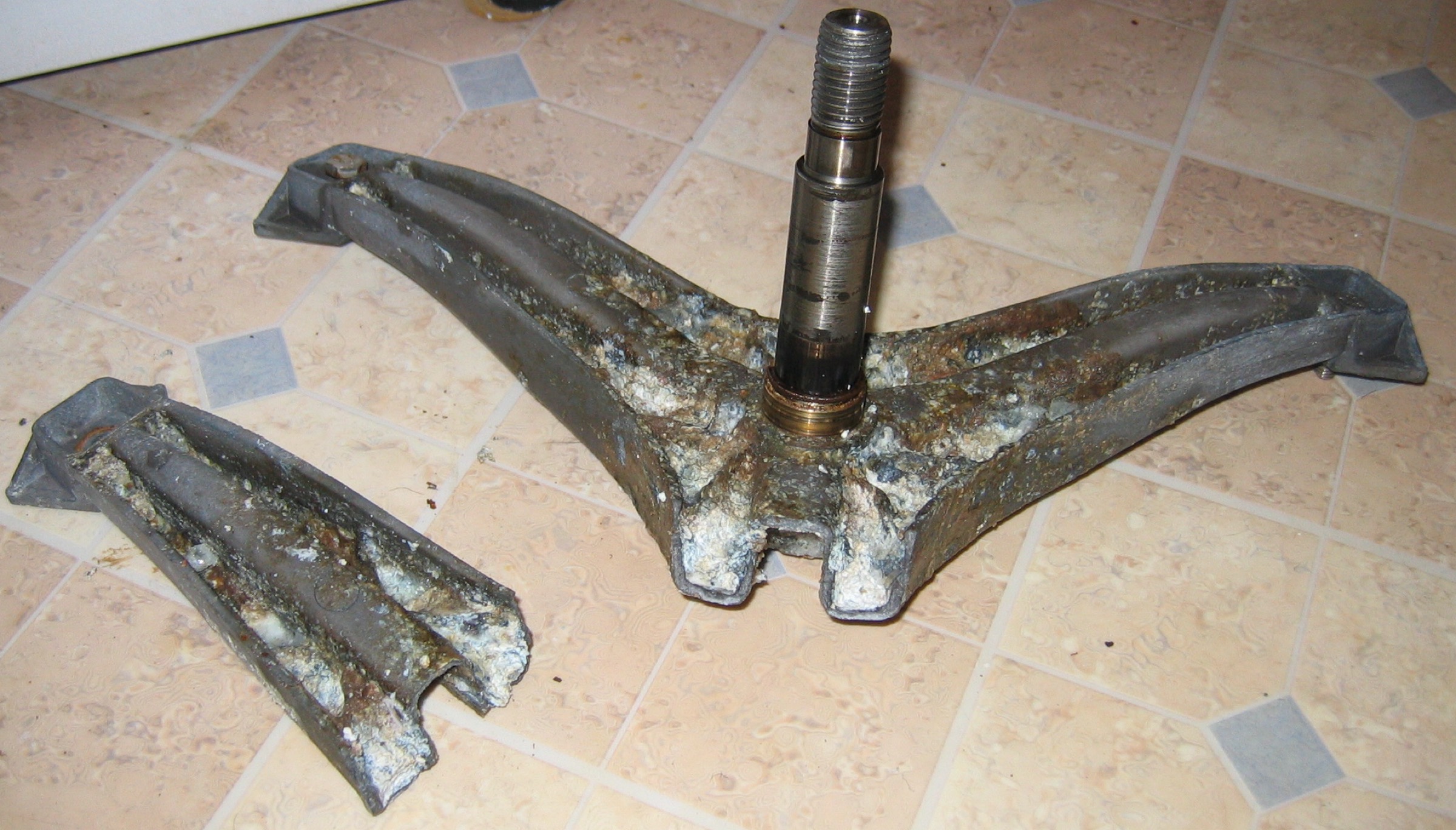
Just look at the example above (thanks to Jim Banks), where you can see the corrosion and obvious failure of the drum spider but note the residues on the alloy of the spider.
Now look at this next image and note you can see similar residues as you see on the spider, that’s obviously completely corroded with a similar residue to the first example.
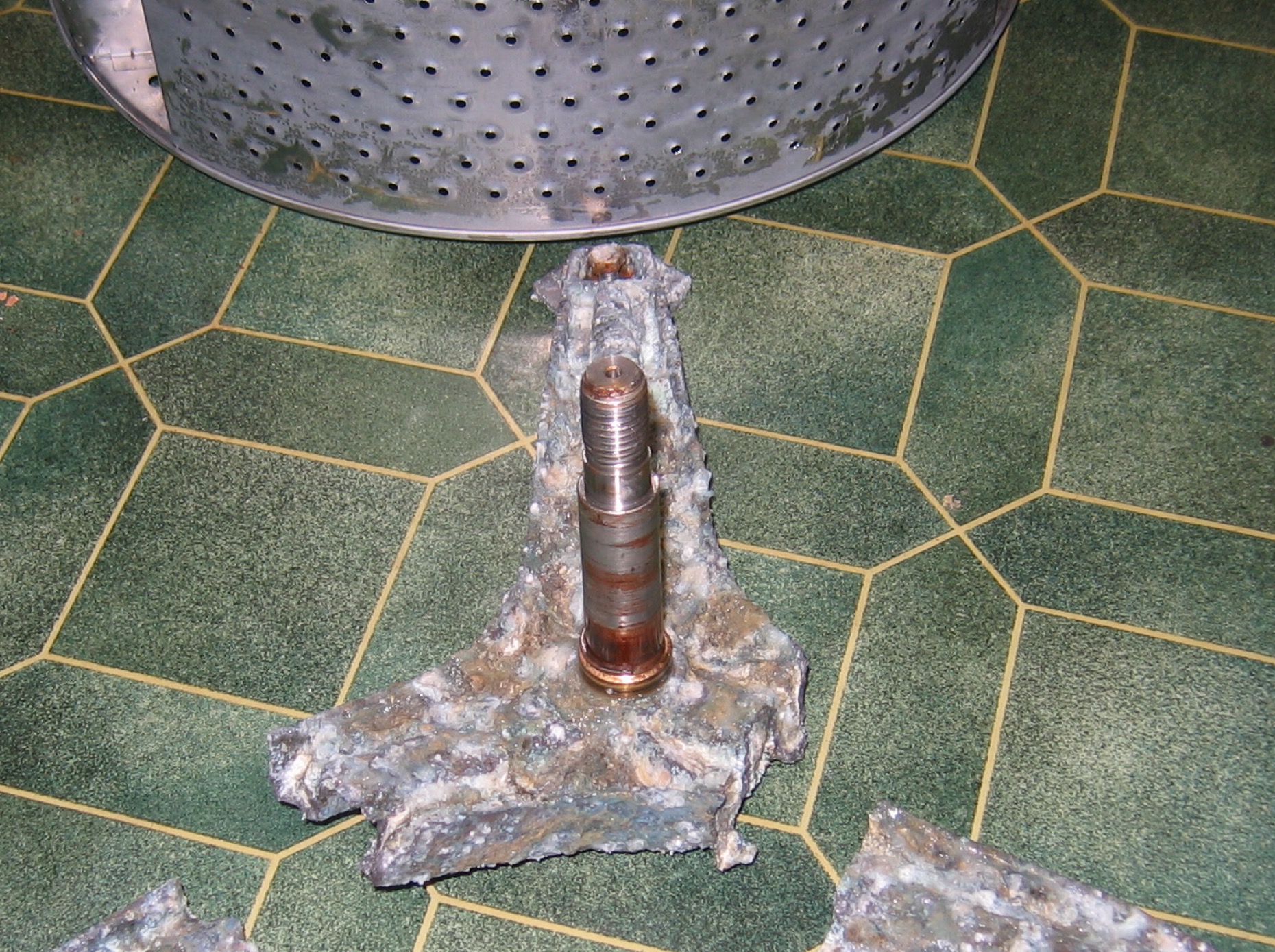
Back in the day, when metal tanks were commonplace, you would see the odd spider failure but, not as much as we see these days. This would anecdotally suggest that either the spiders are not made as well or, something is wrecking them.
We wonder what that might be?
Of course, we can’t *prove* this and that we’re correct but the evidence strongly suggests that we are correct and that biofilms and bacteria in the machines are what’s causing all the spider failures.
Do manufacturers know this? We have no idea, but if they don’t, they really ought to or at least look into it but, that means cost and, that probably won’t happen.
As I started to dig down into this, biofilms and corrosion caused by them to metals, it suddenly all made sense and explained why it is that we see alloy spiders that are horribly corroded in machines that have stainless or enamel tanks. The tanks are fine, the spiders… not so much.
However, it’s rarer on metal tank machines, tends to happen on much older machines and I suspect that’s because there’s not as much gunk in them to attack the alloy.
Whether there is an alternative material that could be used which would be more resistant to this corrosion, I don’t know and I doubt anyone is looking because, by the time they break, all will be outside of warranty and the manufacturer won’t care, not their problem.
Owners, on the other hand, may well care.
On more flimsy cheap machines, how long it might be before a drum spider breaks who knows but, if it’s a sealed tank it’s very likely just going to be scrapped in any event.
Even if it’s not a sealed tank, there’s almost no possibility at all of getting a replacement drum spider, as most simply are not available as a spare part at all or come as part of an expensive drum assembly.
Hence, in all probability, nobody is looking at this as an issue.
2020 & Healthcare
As you can see from any number of articles on this site, we’ve been banging on endlessly about issues of bacteria etc in washing machines and so on for many years. Sometimes we wonder why we bother, as people seem not to pay all that much attention.
Then we hit 2020 and suddenly, for some reason, people cared a bit more.
Bacteria, germs, contamination and so on all of a sudden were headline news for a couple of years. Fast forward a few more years and we’re back to, nobody seems to be all that bothered.
We are.
See, apart from everyday normal people washing their laundry, that they think is coming out clean, probably getting swirled around in a bacteriological soup full of goodness knows what nasties and Lord knows, that’s bad enough. What about healthcare workers?
Just think about it for a moment because, in order to save money a lot of healthcare workers are required to wash their own uniforms and so on at home, in a domestic machine. And we’re not alone in our concerns, as reported here.
These machines we know, there’s loads of evidence, often don’t reach the advertised temperatures, often don’t clean all that well from our testing and may well be harbouring a primordial slime of bacteria in them.
I don’t think further explanation is required beyond asking the question that, if domestic machines are so unsanitary then what’s the chances that a lot of healthcare workers clothing is also unsanitary?
This is not the fault of nurses etc, that needs to be a point that is very highly stressed.
The people who came up with the policy of having healthcare workers in positions where sanitisation is a vital part of what they do should have known this stuff and should have addressed these problems. It’s not news to them; this topic has been covered in various articles and studies over a number of years. It’s a known problem.
Drainage
Just a side note in some regard but in this period we’ve also gone from largely open standpipes to drain washing machines and dishwashers to sealed spigots.
This may not seem like a problem but it can be as it is often seen that mini or partial blockages in the pipework cause the wastewater to “backfill” into the machines. Essentially, the machine is filled with dirty water from the drainage system.
Whilst we don’t view this a a direct cause of creating biofilms in the machines, we very much doubt that it will be helping matters.
False Narratives
All the time we see these issues being laid at the door of detergent companies and, that is unfair. Totally unfair.
It’s been the easy way out for any wash performance problems or issues, skin irritation and more to say, “oh change your detergent, it’ll be that” to send people on their way. By the time they get to checking it out and flipping between goodness knows how many brands it’s likely they just give up. Or, have more Important stuff to deal with and it’s forgotten.
Meanwhile, the washing machine maker and/or clothing maker gets no static.
Having worked with major detergent manufacturers, I can assure you, the care and attention to detail they have for their products is, well, staggering. They have actual scientists working on multiple areas and monumental testing going on to make sure the detergents work, don’t harm and are as environmentally friendly as possible. It’s a huge effort and cost put into it.
When you look at a washing machine plant, it’s archaic by comparison. Or at least, the number I’ve seen have been.
Leaving you to question, if anyone was going to mess this up, who do you think it’d be and the only logical conclusion is, not the detergent producers.
Conspiracy Theories
Whenever we talk about this kinda stuff there is the inevitable theories that pop up to claim that these sorts of things are evidence or built in obsolescence or such things when we argue it’s probably not.
It’s far more likely that commercial pressures, legislative pressures and not thinking through the consequences (or caring) is more to blame.
Just look at the factors at play here where there’s a commercial pressure to make the machines as cheaply as possible, so we get plastic tanks being used to save money and all are forced down that road in order to compete.
Then you have the legislative pressure from having to meet the requirements of energy labels that, if you don’t hit a certain target you’re not competing. So we get programs that do not hit the advertised temperatures but “simulate” them meaning that in bunch of cases the wash may well not be sanitary.
If one or two “cheat” to hit a target and get away with it, chances are others will do the same.
Has anyone thought through the consequences of these kind of things? Probably not.
Where’s any incentive for makers to even give it a second thought?
So we don’t think there’s any big conspiracy here, just a failure of legislators, general human stuff, commercial interests and of course, even if there is a breach of some legislation, nobody seems to care or enforce it.
What Can Be Done?
Without some legislation, people voting with their feet or, wallets is about all that you or anyone can do.
Buy better machines that actually perform as they should do. Ones that wash properly and preferably have stainless steel or enamel outer tanks, if washing machine manufacturers use them they’ll be sure to tell you about it, if they don’t it’s almost certain that the machine will have a plastic tank.
If enough people elect to only buy machines with metal tanks, makers will soon cotton on and serve that requirement.
Likewise, if makers see people demanding that machines reach the proper temperatures and wash performance is up to snuff, they’ll soon remedy what they produce to meet demand.
But that’s down to you as customers. As is, using the machines correctly as well.
In an ideal world we’d like to see more studies into this and, if our suspicions are proven to be correct which, we’re pretty sure they would be, some changes to legislation made.
It’d mean safer machines, cleaner laundry and more sanitary washing as after all that’s the point of the washing machine in the first place, to clean your laundry. They’re not a lot of good if they’re not doing that and even less if they are potentially making you unwell.
Importantly, not having a washing machine that can possibly make you unwell.
Consumer Demand
The most effective way to change things though, is dead simple.
Get people to ask for change.
If enough people demand or buy machines that have metal outer tanks and actually hit the advertised wash temperatures, makers will start to accommodate that requirement.
Or, enough people ask for legislative change to force makers to make better washing machines and it’s done through legislation.
But, either way, it’s going to take people understanding the issues and acting.