
How Water Softening Systems Work
We get lots of water softness or hardness related issues crop up on UK Whitegoods and very few people understand the basic premises behind the system, hopefully this article will de-mystify the process.
Dishwasher Water Softening Theory
 |
Water hardness is caused by the calcium and magnesium ions dissolved in the water. Removing these ions, removes the hardness, making the water softer – hence water softening unit.
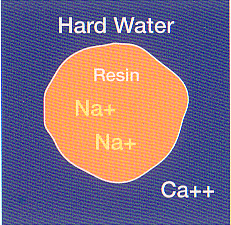
The water softener in dishwashers works by swapping or exchanging the hardness ions for sodium ions which do not interfere with the wash process. To allow this to hapen, the water is passed through an Ion Exchange resin. This resin has the appearance of brown sugar. If we could look at the surface of the resin particles we would see that it was coated with sodium ions, represented here as Na+. |
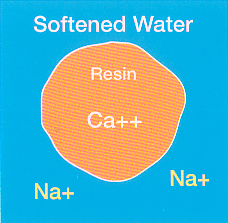 |
When hard water passes through the water softening unit it flows through the ion exchange resin coming into contact with the particle surface which is coated in the sodium ions (Na+).
The resin has a greater affinity for the hardness ions, calcium (Ca++) and magnesium (Mg++) Therefore an ion exchange takes place where, for example, on Ca++ from the water replaces two Na+ on the surface of the resin particle. The two Na+ ions are now in the water and the removal of the Ca++ and Mg++ means that the water is softer. |
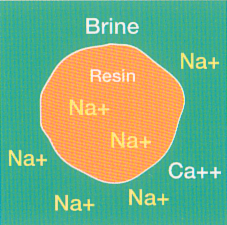 |
Eventually all the sodium ions (Na+) will be replaced with hardness ions (Ca++ & Mg++). In order to soften more water the ion exchange resin in the water softener must ne regenerated. To do this the Ca++ must be removed from the resin and replaced with Na+ to drive the ion exchange process in reverse. The cheapest source of sodium ions is salt – sodium chloride. The concentrated salt solution, commonly known as Brine, is generated by allowing water into the salt container. |
Dishwasher Water Softener System
Below is a schematic of a dishwasher water softener system. There are slight variations between manufacturers but the basic principle is the same.
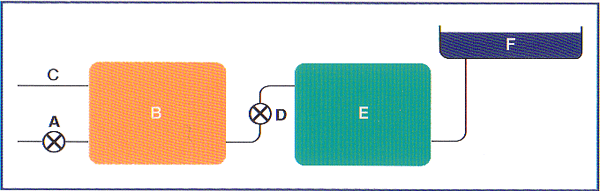
I. When the machine needs to fill with water it will open a valve A. Water flows through the ion exchange resin, B where the water hardness is removed as detailed earlier. The softened water then flows out the resin container and into the machine via C.
II. Eventually the machine must regenerate the softener resin. to do this it need to know the approximate hardness of the water it has been softening. This is only achieved if the salt setting is adjusted correctly The salt setting provides information allowing the machine to determine:-
1. How much of the resin needs regenerating every cycle (older machines)
OR
2. How often to completely regenerate the whole softener unit (newer machines)
III. When the resin requires regenerating the machine will open valve D, the outlet to the salt container E. A small header tankof water F can now empty into the salt container. This displaces the brine (concentrated salt solution) in E. The brine flows into B where the sodium ions (Na+) replace teh hardness ions (Ca++ & Mg++) on the surface of the resin particles as described previously.
IV. The machine will now close valve D and open valve A. The brine in the resin (now containing the water hardness removed from the wash container, often known as “spent brine”) flows into the machine and is pumped straight out the drain. This is done when the wash pump is switched off so that the spent brine does not come into contact with the wash load. Finally, the machine will re-fill F ready for the next regeneration.
Reprinted from “The Art Of Laundry” produced by Procter & Gamble.
I’m glad I stumbled over this article. I have been looking to get the material to recharge by dishwasher water softener. The term “ion exchange resin” was the search term I needed. I now have a source to get the material. Good job! Thanks!
Can anybody help me in how to take off the drain pump on my Beko machine. I can\’t seem to get it to budge
Does resin quantity affects the ability to soften the water?
Please help me why water is coming out of the water softner
I accidentally put table salt instead of dishwasher salt, how can I correct this and prevent damage to my dishwasher
My dishwasher has been through a wash cycle without the lid on the salt container resulting in a deposit on the crockery and round the machine. What has happened and what is the cure?
Water leaks out from the fill chamber joint to the softener unit with new seals. I am replacing both. I think that the ION EXCHANGE RESIN over time gets clogged and causes build of pressure at the joint seals. What do you think? This is a Whirlpool 854549515840.