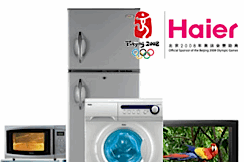
Sanyo Electric said yesterday it had reached an agreement with Haier to sell its white goods operations, such as refrigerators and washing machines, to the Chinese company.
The deal is the first time a Chinese firm has bought major business segments from a large Japanese manufacturer. The value of the transaction is undisclosed.
The sale follows a basic agreement reached in July with Panasonic, Sanyo’s parent, for Haier to gradually acquire Sanyo’s refrigerator and washing machine operations in Japan and Southeast Asia by the end of March 2012.
Under the deal, Haier will have the right to sell washing machines, consumer refrigerators, and televisions under the Sanyo brand in Vietnam, Indonesia, the Philippines and Malaysia.
In Japan, the Chinese firm will use both “Haier” and the “AQUA” brand name, currently used as a Sanyo product line.
“Following the final agreement, the two companies are aiming to complete the gradual transfer of the businesses by the end of March, 2012,” Sanyo said in a statement.
Panasonic and Sanyo are looking to jettison overlapping businesses, with Panasonic looking to focus more environmental technology such as reachargeable batteries, solar panels and other energy-saving systems.
It acquired a majority stake in Sanyo in December 2009, taking over one of the world’s biggest suppliers of rechargeable lithium-ion batteries and a major player in solar panels, before turning it into a wholly owned unit.
It said in July that it would sell Sanyo’s white goods operations to Haier for an undisclosed sum.
Haier was the world’s largest refrigerator maker in 2010, controlling 13 percent of the market, while ranking second in washing machines, with a nine percent global share.
But the company has been struggling to boost its presence in Japan and Southeast Asia, where Japanese brands are strong.