

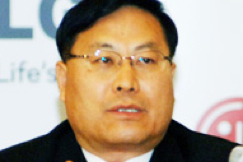
Lee Young-ha, the head of LG Electronics’ home appliance division, says that LG Electronics, which competes with the likes of Whirlpool and Electrolux for global supremacy in home appliances, aims to be the industry’s undisputed kingpin by 2014.
In order to achieve that goal, the Koreans are hoping to get a boost from their commitment to “smart-home” technology, which allows people to interact with their household gadgets and control them via their mobile phones.
Getting early out of the gate in smart appliances will enable the company to leverage its strengths across a broader range of products and services, Lee said. The company is targeting $20 billion in annual revenue by 2014.
“We look at `smart’ appliances as a natural course of evolution, rather than as something limited to the high-end market. The transition is a must and we need to find a way to provide a smooth experience to consumers without forcing them to pay too much extra,” Lee said in a meeting with Korean journalists on the sidelines of the International Consumer Electronics Show (CES) in Las Vegas.
“We are one of the few companies that could provide more than just the gadgets but the total solutions that link the appliances with home network systems. The possibilities are immense and our smart-grid-readiness could provide us a distinct advantage in markets like the United States, which is showing more urgency than others in innovating energy management.”
Does this mean that soon people will be able to have a complete home automation (HA) system that is completely LG produced? The problem here is that there are competing HA systems already in the market, some of them very well adopted by the people that want and, can afford, such systems and it seems unlikely that the mass market will jump at this. Especially so if you have to replace all your appliances, TV and so on with LG devices to actually make use of the system. LG showed off its updated lineup of THINQ series of smart appliances at the CES. The technology is dependent on the presence of smart grids, which deliver electricity from suppliers to consumers using digital technology, enabling devices to communicate with utility firms to purportedly save energy, reduce household spending and enhance reliability.
LG’s washers designed under the THINQ concept automatically do the laundry in the most cost-effective time, the company claims, while refrigerators adjust to save energy costs at peak times.
The Internet connectivity of the gadgets enables them to interact with users, who can also download software and applications on them. The self-diagnosis system of the appliances alerts users and local LG technicians of any functional problems.
We have to wonder how long it is before someone hacks an internet enabled fridge. But, in the meantime, big brother is watching.
LG sees a potential business goldmine in wastewater treatment technologies and services, and has been increasing its research and development efforts. The company is also marketing its “green-membrane bio reactor” (G-MBR) technology, which employs ultra-thin membrane modules that allow bioreactors to be built smaller. G-MBR removes almost twice as much phosphorous than conventional bioreactors, making them more effective in protecting lakes, ponds and other bodies of water, company officials said.
LG also aims to strengthen its built-in appliances business in the North American and Europe markets, which would be crucial for improving market shares in ovens, dishwashers and refrigerators. The company recently inked a partnership with American built-in appliance firm, Viking, to develop products that are more attentive to the tastes of local consumers, Lee said. LG expects to generate 1 trillion won (about £550 million) from its built-in appliance business by 2015.
Expanding our shares in built-in appliances will cement our reputation as a premium brand. Aside of advanced markets, emerging markets like Brazil and African nations are also targets,” Lee said.
LG currently runs 11 manufacturing factors overseas that produce 13 types of home appliance products, which gives the company more freedom in manufacturing products tailored for local markets, such as low-power refrigerators for African countries, Lee said.