
Frost Free Fridges And Freezers
The reason that is being written is because we get asked constantly and have to answer the same questions over and over about frost free fridge freezers. It’s the same old questions again and again, “it doesn’t cool so what’s wrong?’, ‘The motor doesn’t run, what’s wrong?”, “it’s full of ice, why?” and so on.
So this article is so that you, before you ask engineers questions that are basic fault finding, to help you to help yourself and get quicker answers. In order to do that you will almost certainly have to learn the very basics of fault finding and diagnosing problems with your frost free fridge freezer.
It is important that you read this article fully so as to understand and diagnose the problem with your fridge freezer correctly or, to allow us to help you without simply referring you back here to read it again!
It is also very important to realise that this appliance is used to store food in that you will consume under ideal or close to ideal conditions. This is vital if you do not want food poisoning, we will assume that you do not wish this to happen. It is therefore imperative that the fridge or freezer operates correctly and maintains the temperatures correctly to prevent any danger from incorrectly stored food.
However, first of all it is important to know what we see when we look these machines up or try to look up spare parts.
Technical Information We For Fridge Freezers
Generally, we will see a spare part breakdown of any appliance that is a little something like the diagram below.
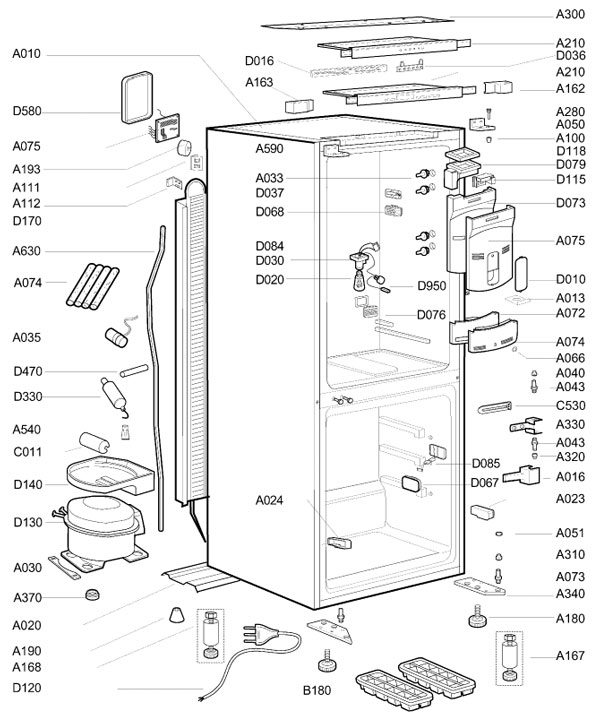
Not a lot is it?
Apart from this, on a good day and if we’re lucky, we might even get a wiring diagram. By wiring diagram we mean some schematic that tells you what is connected to what, resistance vales and whatnot for thermistors are almost never given so it is utterly pointless asking as we don’t have that information.
The manufacturers expect (some say rightly, others do not) that anyone attempting to repair their appliances will have the relevant knowledge to do so. This means that they do not and, will not, write step-by-step manuals that will instruct you on how to repair your appliance. Full stop, end of story.
Manufacturers expect that any of their appointed agents will attend any range training, which offers training on a range of products or that they will have the nonce to suss each machine out. They do not provide manuals for each product even there as the machines are, whilst often slightly different, largely the same basic chassis.
Many times the independents are left with, well, nothing really.
So please understand that we are not sat on a pile of information that we can send as, in most instances, it simply does not exist.
You have to be prepared to work it out for yourself and, if you are not prepared or don’t feel able to do that, do not attempt it and phone an engineer!
Understanding Frost Free Fridges And Freezers
The first step in this process, if you have decided to have a crack at fixing your own fridge or freezer, is to actually understand the basic principles of what is happening. There are other articles on the site (in this section) that will help you to do that but you have to know some basics.
To work frost free fridges need certain things to operate correctly, if any of the following does not happen then it will fail to chill correctly.
All fans must be free of ice and able to operate as intended
Airflow is absolutely key inside a frost free fridge freezer. The air must be able to circulate so that food is properly chilled or frozen as, unlike a “falling air” machine that is not frost free the evaporator is at the back or top of the freezer section normally.
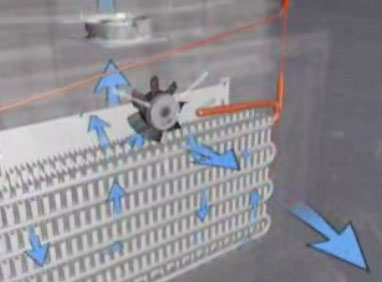
What this means is that the fans, as in the picture above, must be able to turn and blow cold air into the fridge and, where appropriate, the fridge section as well.
If these fans are blocked or faulty then the fridge will not cool or the freezer not freeze correctly.
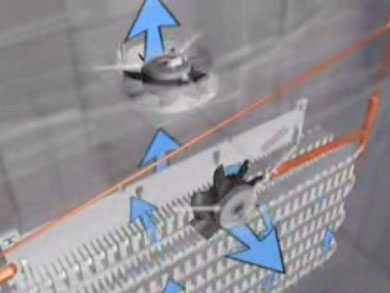
As above there must also, where the fridge cold air supply is drawn from the freezer, be a fan to drive the air into that fridge cavity and this is especially so in the case of an American style fridge freezer. You will also often find an electrically or thermostatically controlled air flap there to control the airflow into the fridge. In essence the cold air is “drawn off” the freezer section.
Flap fails, no cold air get into the fridge.
Fan fails, no cold air into the fridge.
Also employed in many European frost free fridge freezers is a standard “falling air” fridge with a forced air freezer below that.
Fridge & Freezer Fan Motor
Every frost free fridge or freezer will have at least one fan motor. To operate a frost free system the air cooled by the refrigeration system and, ultimately, the evaporator must be blown used forced air into the cavity.
Almost every fan motor is a simple affair that can easily be checked for continuity with a simple multimeter. So long as it is not open circuit then it will probably be okay.
Recently we have seen the introduction of variable speed fan motors (as well as compressors) in order to improve the energy efficiency of fridge freezers. These will generally be controlled by a small PCB that will regulate the voltage being sent to the actual fan motor rather than the motor simply being switched on or off by means of a thermostat in older non-electronic systems or an electronic controller in more modern fridge freezers.
To replace fan motors can be expensive and some are difficult to replace as they are often not the most accessible of components. Often pipework has to be moved and, if you damage that, you will need a professional fridge engineer to regass the fridge freezer.
Freezer Defrost Heater
The defrost heater is a simple heating element which will be located around the freezer evaporator and is designed to melt away ice that has formed on the evaporator on what is referred to as a defrost cycle
Virtually every defrost heater can be checked for continuity with a simple multimeter. The resistance is not really that important, what is important is that it is not open circuit.
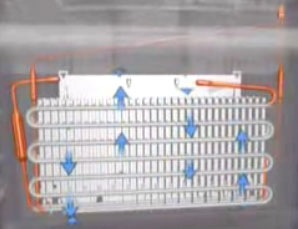
This heater is normally wrapped around the evaporator (a typical frost free freezer evaporator shown in diagram above) in the freezer and can be a very awkward spare part to replace that is, if it can be replaced as a spare part. Increasingly, to get manufacturing costs down, these are being supplied with a complete evaporator so, instead of paying about £10-20 for a simple heating element you end up spending close on £100 as is the case with Samsung American fridge freezers.
Often the heater can be replaced with care where this is the case but, do note the “with care”. It is also not designed to be easily serviceable.
Fridge & Freezer Thermistors
These are the temperature sensors that send back the current temperature inside the fridge and freezer to the electronics
Thermistors are simple things. All they do is change resistance based on the temperature into which they are installed, this resistance is reported to the electronic controller and the controller then decides using it’s internal logic what to do with that information.
In this self help section there is an article on thermistors and how to check for faults on them.
Fridge Freezer Electronic Controller
This is the logic centre of the whole appliance that will read the temperatures given by the thermistors and control when the compressor switches on and off to cool, when the defrost cycle is run and when to cut in and out fans, often including any cooling fans
It is easy for many people to simple “assume” that the electronic controller is at fault but, with some notable exceptions (such as Whirlpool American style fridge freezers made in Italy and many Diplomat models), it is usually the last component that an engineer will replace for two fundamental reasons. The first is that, on the whole, the electronic cards used in fridge freezers are not under a great deal of stress and therefore do not tend to fail too often and that they are usually the most expensive option. It is unwise at best to replace the most expensive component on the strength of guesswork.
Our advice is to thoroughly check all the other components are operational BEFORE even assuming that there is a problem with the electronic control unit unless you’ve had a look through our forums and identified it as a particular problem on your model.
Also do bear in mind that if you put a board in and find that’s not the problem you won’t be able to return it as it is then considered to be used.
Freezer Defrost Timer
On older and lower cost machines you may well find a defrost timer instead of an electronic control unit.
These are small electrical timers that operate the defrost cycle on, usually, four, six, eight, twelve or twenty four hour cycles. What they do is essentially run and cut in the defrost heater as required depending on the fridge freezer’s requirement for defrosting.
Although these are pretty standard in some machines with timers from Ranco mainly, it is important that you get one with the correct defrost time or the fridge freezer could over freeze, causing the ice build up failure or defrost too often causing food not to be stored under the correct conditions.
Freezer Defrost Thermostats
You may, on some fridge freezer models, have what is known as a defrost termination or a defrost initiation thermostat and, in some cases these functions will be combined.
These thermostats, fitted to some, will feed back when the evaporator requires defrosted and initiate and/or terminate the defrost cycle.
If fitted it is possible for these to fail and if they do not operate correctly then you can get no defrost cycle being initiated or, the machine in an almost permanent defrost cycle.
Whilst on a defrost cycle the compressor will not run and, therefore, the fridge freezer will not cool.
Diagnosing Frost Free Fridge Freezer Faults
Now that you have a grasp of the basic components and what they do please don’t consider that you are an expert but, basic fault diagnosis should be possible for most people with some elementary electrical and mechanical skills. If you don’t think you have these basic skills, call an engineer as it is easy to do more harm than good!
Overfreezing Or Ice Build Up
- Check thermistors or thermostats are operating correctly
- Check fan motor/s are running and free of any ice build up
- Check that the defrost heater is okay using a multimeter
If all of those check out then look to see what sort of ice it is, is it clear and smooth or is it white and “powdery” like snow? The former indicates water freezing up where it shouldn’t be usually and the latter would indicate air ingress, so check the door seal.
Fridge Freezer Not Cooling
Is the compressor running at all, do you hear it trying to start?
The compressor is an electric motor encased in a metal housing that compresses the gas used (normally R600a these days and previously R134a) which, under pressure, is pumped around the pipework of the fridge freezer. This gas system is a sealed one using a very small amount of refrigerant gas and, as it is sealed, it does not need topped up with gas. The compressor is sent a signal to start, based on the internal temperature either by the electronics or by a thermostat.
It is possible that, if the compressor does not run, that the start relay is faulty which is attached to the side of the unit. Usually there’s a wiring diagram on that so that you can check it with a multimeter but, again, this assumes that you have a basic electrical knowledge.
A quick tip is that, if you hear a click-buzz from the compressor and it doesn’t start it is highly probable that the compressor is faulty and this is the noise it will make cutting out on the safety klixon/relay.
If it is an electronic unit with a display, is there a fault code being displayed?
If the fridge freezer is an electronically controlled unit it will, normally, display some sort of error code if it encounters a problem. However, like most fault codes, it will generally give an indication of where to look for the problem or failure, it won’t normally pin point the exact failure for you.
- Is the evaporator cold to the touch but no air is being forced from the fan?
- Are the fans running?
On frost free fridge freezers it is very common, as str ange as this may sound, to get a “not cooling” fault because of over freezing. I know that sounds odd but what happens is that, should the machine not defrost correctly the evaporator will over freeze leading to an ice build up which jams the fan. This means that air is not forced into the cabinet and it will then appear as if the unit is not cooling.
A Look Inside A Frost Free Fridge Freezer
We’ll look at the fridge freezer that the exploded diagram shows on the first page of this article to walk you through the general principles of a frost free fridge freezer.
Blowout diagram showing the main view of the fridge freezer.
The first diagram, shown above again just to save you jumping back a page, shows the main blowout of the fridge freezer. We’ll go over all the main bits and use a separate diagram to show the freezer.
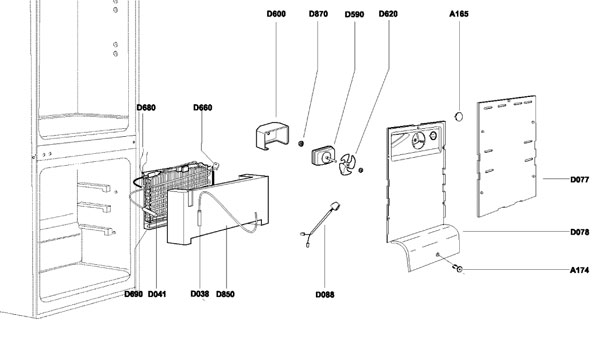
Blowout diagram showing the freezer evaporator, fan motor and thermostat.
What you see here is the internals of the freezer section in this integrated fridge freezer blown out for spare part identification. It is a good example as it has most of that parts that you would ever be likely to see for most fridge freezers.
Now, on the parts diagram you would think that part D680 was the defrost element as it points to the two wires but, like many these days, it isn’t actually available as a spare part. Instead, you have to buy the complete freezer evaporator to replace a simple heater. This is becoming a more common practice on cheaper units to keep down production costs but, to replace this heater would cost you well in excess of £100 plus a regass of the fridge!
D041 and D038 are the thermistors or sensors that detect the temperature inside the freezer, in this case also initiating the defrost cycle as the defrost initiation thermostat, shown in this diagram as D088, isn’t actually fitted on this model.
D850 is a baffle to keep the cooled air in the evaporator area so you don’t get a cold spot in the freezer and also to reduce noise.
The cold air is drawn up and forced out into the freezer by the fan motor, shown as D590 through the two baffle plates to the right of that. The baffle plates are the bits you actually see at the back of the freezer which, if you want to get into the workings, need to be removed.
Fridge Freezer Electronic Control Unit
The control unit is, here, split across two different diagrams and also shows two types of electronic control unit having been fitted.
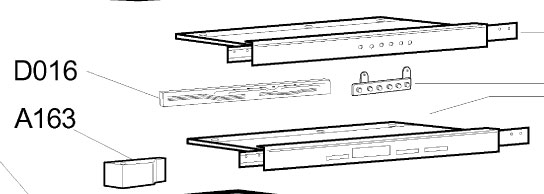
On the main blowout diagram the control module is shown as D016.
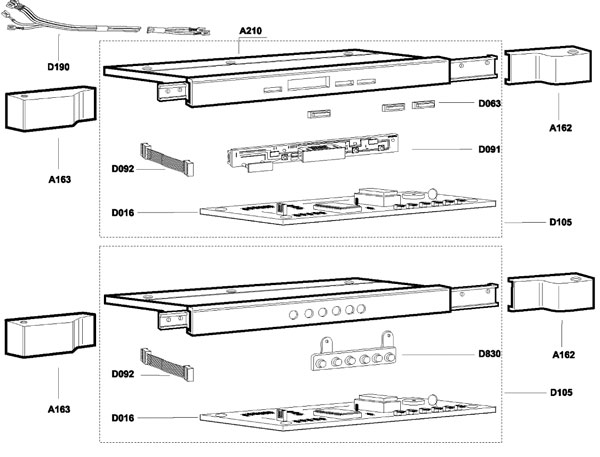
Then when you get the more detailed diagram for this machine you can see the two variant, one with and the other without a digital display.
For people that don’t work with this sort of stuff every day this can be very confusing but, it is very common that you will have multiple variants of the one appliance shown on a diagram in much the same way as you can have multiple instruction manuals covering multiple variants. Each one of these will be differentiated by either the model number or the serial number and this is the reason we require the correct information from the rating plate.
Final Notes
This article should give you a rudimentary understanding of the general principles of almost any frost free fridge freezer but, there can be marked differences from brand to brand and from model to model.
It is very important however if you choose to attempt to repair your fridge freezer that you sit and logically work out the problem. Appliance repairers have the advantage of many years experience in diagnosing and tracing faults and in order to get that knowledge it takes a lot of time sitting watching appliances and understanding how they work. When you call an engineer you are paying for that knowledge and experience to minimi se the downtime due to a failure.
If you do not have the patience to try to understand the machine, how it works and what it does we would suggest that you may well be better advised to call in a professional. Asides from which, incorrectly stored food can be dangerous to your health.
when the fridges auto defrost activates the power in the trips.
I have a Montgomery Wards frostless rrfridgerator / freezer model # HMG238747B the freezer wont freeze water into ice cubes but will keep a bag of ice from the store for 3 weeks but the fridge underneath is just below room temp. Your much valued opinion Mistro B.D.
i have a frost free samsung fridge freezer and an audible alarm keeps sounding for no apparent reason your comments please?
Hi Ken,There will be a reason for the freezer alarm going off, the trick is to finding out what’s causing it. There are no obvious things usually and it can be caused by numerous issues.
My Samsung Frost free Fridge Freezer starts up. I can hear the fan going but it cuts out and a code rd appear in the display panel what can be the problem.
I think it’s the refrigerator (fridge) defrost sensor reading an error but I’m not entirely sure.You are better to use the forums for that sort of question where the engineers will see it and likely be able to answer you.
Just replaced the thermostat on my Zanussi ZI018/12K Fridge/Freezer but now the internal light does not work any suggestions. There is no pwr at the 2 White leads!
s20erss2v whirlpool american fridge help needed . the baffle into the fridge keeps breaking because it sticks with ice and when the motor tries to shut the gate to adjust the temp it snaps the baffle gate . im reluctant to buy a new one as im prettu sure it will do the same on the new one . can anything be causing this to ice up .
MY COOL ROOM NOT ENOUGH COOL .I FAUND THAT NEAR THE COMPRESSOR SUCTION LINE ICE BUILD UP/1-GAS R22COMPRESSOR 10 HP
Beko fridge freezer: CDA 554W: To release the thermostat from the light housing, do you pull off the temperature control dial or is there a hidden screw? Thanks, Kenneth
If you ask in the forums one of the engineers may be able to answer that.
Hi, any help? My service freezer frost free model m0330s has a fault, the three led’s keep on flickering and there is a noise coming from the relay’s, i have tried to find out if any component is bad or burnt by just looking at it, seems ok, has any one had same problem or can any one let me know which component would be at fault and how to check it.
I have a Lamona American fridge freezer and I feel to works as far as temperature is concerned but I feel it is even noisier than usualWhat thoughts?
Noise level is a very subjective thing, as explained here…http://www.ukwhitegoods.co.uk/help/buying-advice/all-appliances/2910-appliance-sound-levels.html
[quote name=”s20e rss2v whirlpool”]s20erss2v whirlpool american fridge help needed . the baffle into the fridge keeps breaking because it sticks with ice and when the motor tries to shut the gate to adjust the temp it snaps the baffle gate . im reluctant to buy a new one as im prettu sure it will do the same on the new one . can anything be causing this to ice up .[/quote]Hi, you’ll probably find that the door cams hav worn on the fridge, check to see if the fridge door is lower than the reezer door, also check to see if the door is rocking when you open it (about half way open) also check the door closes properly.the cams are easy enough to change, just a pain in the a*** because you have to take the door off, it’s only £ 8mm bolts though
My hotpoint frost free fridge freezer is having problems cooling the fridge, freezer works, but the fan hasn’t come on for ages.THERE IS ALSO NO ICE BUILD UPIVE TURNED OFF UNIT FOR DAYS, SAME PROBLEM WHEN TURNED BACK ON.
Hello can you tell me which brand/model those diagrams are from? Looks identical to mine that has just developed a cooling issue but its unbranded with no identifying marks on that I have so far found?
Diagrams are for Servis.
I have a Whirlpool free standing frost free tall freezer which has started recently making noise similar to liquid running when I close the door. The food is remaining frozen and it is holding its temperature. Can you suggest any idea as to what the problem might be?Many thanks.
beko fridge freezing in the bottom.where the fult?