
A report released in the past few days has indicated that the repair market is set to grow over the next few years, primarily driven by environmental concerns, right to repair, governments pushing repairs over replacement and costs but there are problems which we seem never to be done highlighting.
One of the big hurdles to repairs, as we have repeatedly pointed out, is manufacturers and brand owners being unwilling to share spares and technical data. Which hampers repar efforts and stifles competition that, we suspect, is exactly the reason for doing so.
For repairs to become more viable and increase, we have repeatedly said that two relatively simple measures are required: that spares and technical information is made freely available and that VAT is either reduced or removed from repairs and spare parts.
On VAT, this is repair and replacement spare parts, not new goods and not what we say were luxury goods plus VAT was already paid when the appliance was purchased in the first place.
Anyway, the full press release is as follows:
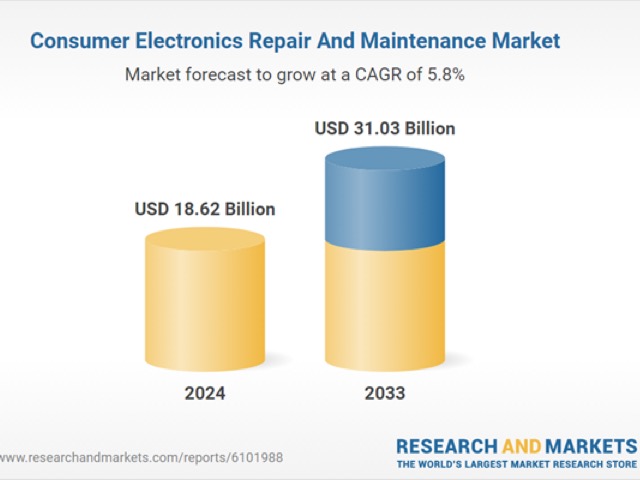
The global consumer electronics repair market, valued at USD 18.62 billion in 2024, is projected to grow to USD 31.03 billion by 2033, fueled by a 5.84% CAGR from 2025-2033. This growth is driven by the demand for prolonged device lifecycles, cost-effective repair solutions, sustainability, and e-waste reduction. The sector encompasses various products and services, including authorized and independent repair providers for home appliances, personal and entertainment devices. Key growth factors include electronic waste management, cost-efficiency over replacements, and government support for right-to-repair initiatives, despite challenges like limited spare parts availability and rapid tech advancements. Major markets include the US, France, India, and Saudi Arabia, with leading players like uBreakiFix and Best Buy shaping the landscape.
Consumer Electronics Repair And Maintenance Market
Dublin, July 24, 2025 (GLOBE NEWSWIRE) — The “Consumer Electronics Repair And Maintenance Market Size and Growth Trends and Forecast Report 2025-2033” report has been added to ResearchAndMarkets.com’s offering.
The size of the global consumer electronics repair market was US$ 18.62 billion in 2024 and is expected to increase steadily to reach US$ 31.03 billion by 2033, this growth is represented by a compound annual growth rate (CAGR) of 5.84% between the periods 2025-2033, due to expanding demand for longer device lifecycles, affordable repair services, and growing awareness of sustainability and electronic waste reduction globally.
Consumer Electronics Repair and Maintenance entails inspecting, diagnosing, servicing, and rehabilitating electronic gadgets like smartphones, laptops, TVs, audio equipment, gaming machines, and domestic appliances. The aim is to make these products operate optimally and prolong their usable life. Services can extend to hardware replacement, software fixes, cleaning, refurbishment of parts, and fault troubleshooting for wear, electrical, or physical damage.
Worldwide, this sector is essential in minimizing electronic waste, saving resources, and providing customers with affordable options for replacing faulty devices. Both developed and developing nations have repair and maintenance services that sustain the circular economy and close the digital divide by making technology accessible and functional for increased durations. With growing environmental consciousness and the rising expense of new devices, businesses and consumers alike are resorting to professional repair services. Furthermore, right-to-repair campaigns and green legislation are also increasing the demand for repair services globally.
Drivers of Growth in the Consumer Electronics Repair and Maintenance Market
Increased Electronic Waste and Environmental Consciousness
The global increase in electronic waste is compelling consumers and governments alike to find eco-friendly alternatives. Repair and maintenance services provide a sustainable alternative by lengthening the life of devices and keeping them out of landfills. Increasing concern over the environmental effects of waste electronics, in conjunction with increased e-waste management regulations, is motivating consumers to repair devices instead of replacing them.
This transition enables a circular economy, reduces carbon footprints, and creates demand for professional repair technicians and certified service centers, turning sustainability into a driving force behind growth in the global electronics repair and maintenance industry. 62 million tonnes of e-waste were generated in 2022, up by 82% from 2010, with an estimated growth to 82 million tonnes by 2030. The waste contains billions worth of valuable resources, but recycling covers only 1% of rare earth element demand. The 62 million tonnes could fill 1.55 million 40-tonne trucks, which could go around the equator.
Cost-Effectiveness in Relation to Device Replacement
Replacement of high-end consumer electronics comes at a price. For many homes and enterprises, fixing faulty products is an inexpensive alternative. Increasing the price of new home appliances, smartphones, and laptops is forcing customers to look for inexpensive repairs as an alternative.
Furthermore, frugal customers in the emerging economies rely more and more on maintenance services to maintain their electronics and maximize their lifecycles. This trend, along with access to low-cost spare parts and technician services, is increasingly making repair and maintenance a more viable and cost-effective option, thus powering market growth in both developed and developing markets.
Government Support and Right-to-Repair Initiatives
Right-to-repair initiatives by government are also responsible for driving growth in the consumer electronics repair market. Policies allowing consumers and third-party technicians access to manuals, diagnostic equipment, and spare parts have diminished manufacturer dominance of repairs. The U.S., the EU, and India are adopting or proposing legislation to aid independent repair enterprises and empower consumers.
These reforms are reducing entry barriers for small repair shops, increasing consumer confidence, and promoting responsible consumption patterns, which in aggregate propel growth in the global repair and maintenance services market. In March 2023, The European Commission set out a proposed Directive on the “Right to Repair” to apply to regulated products such as household appliances, TVs, welding equipment, vacuum cleaners, servers, data storage products, and mobile phones. The proposal seeks to encourage repair and reuse through a number of measures.
Challenges in the Consumer Electronics Repair and Maintenance Market
Restricted Availability of Spare Parts and Technical Information
One of the largest challenges in the repair market is limited access to necessary spare parts and repair guides. Most manufacturers continue to closely manage their supply chains and restrict the availability of proprietary components, to the detriment of third-party repair operators and at higher repair costs.
This denial of access discourages competition as well as postpones delivery of service, frustrating customers. The problem is particularly acute in areas without regulatory enforcement of right-to-repair legislation. If left unresolved, these hindrances can hamper market development and diminish the overall effectiveness of repair and maintenance services globally.
Rapid Technological Advancements and Product Complexity
New consumer electronics are increasingly smaller and more technologically sophisticated, with features such as AI chips, IoT connectivity, and sealed components. Whereas innovation enhances user experience, it makes it difficult to repair. Specialized education and sophisticated equipment are needed to maintain these sophisticated devices, increasing costs of operation and decreasing the number of trained technicians.
Rapid product cycles also mean repair shops have to continuously update their skills and inventory. This complexity renders repairs more costly and time-consuming, and will cause some consumers to switch to replacements instead, thus presenting a major challenge to the market.
Key Players Analysis: Overview, Key Persons, Recent Development & Strategies, Revenue Analysis
-
The Cableshoppe
-
Redington Services
-
Electronix Services
-
B2X Care Solutions
-
Encompass Parts
-
uBreakiFix
-
Asurion, LLC
-
Best Buy Co. Inc.