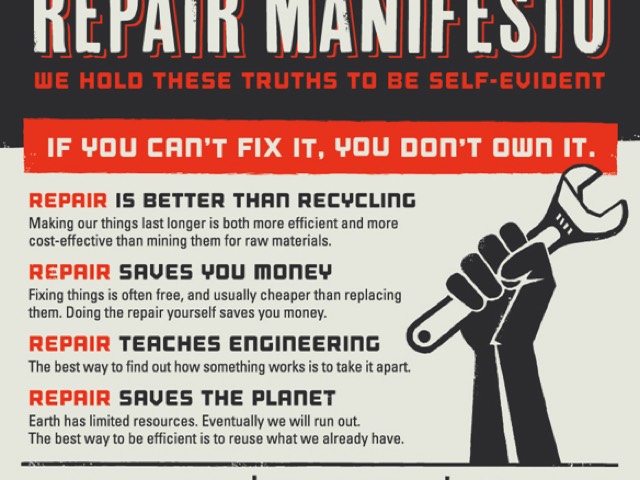
RTR, Right To Repair has taken another step forward as lawmakers slowly wake up to people wanting to be able to repair products they own for both sound environmental and financial reasons.
The latest is in the USA, where Oregon Governor Tina Kotek has signed the state’s Right to Repair bill into law, and it even comes with a provision that possibly make it stronger than both the California and Minnesota’s RTR laws.
It’s the first to prohibit a practice called “parts pairing,” which requires the use of certain proprietary components for repair.
Parts pairing essentially prevents third-party repair services from replacing a broken component with one that didn’t come from the brand itself because it wouldn’t work with the company’s software. People would usually get error messages if they try to install a non-genuine part, forcing them to buy from the company itself.
Think on it like the messages you would get putting a non-original ink cartridge in your printer or something along those lines. But what will be most interesting is if that would apply to the supply of unprogrammed modules, a common practice in the appliance industry where a replacement board is supplied blank with no programming. This means that, without special equipment that most will not have access to, it’s not possible to replace many electronic modules.
This forces owners back to manufacturer service only as there is no other option, in effect creating a micro-monopoly for the brand owner on servicing. They can charge what they like.
Meanwhile, under these new rules in the USA, preventing an independent provider from installing off-brand parts is outlawed. So, too, is reducing the performance of a device that had been fixed with an unauthorised component. Now makers are no longer allowed to give those error messages and warnings at all.
The new rules don’t cover devices that are already out, though, and will only apply to anything manufactured after January 1, 2025.
This is the more “robust” sort of approach that we were hoping that the EU would adopt, which would force the entire EU market and makers that wanted to sell in the region to adhere to. In fairness, we’d go even further than this, which we’ve discussed on this site many times and we’ve highlighted many of the practises that we feel are, at best, a bit iffy.
But here’s the kicker that would really have an effect in the whitegoods industry if it is replicated elsewhere, manufacturers and so forth are also required to make documentation on how to fix their products, as well as make available any special tools needed to repair them to repair outlets.
Worse, from makers point of view at least is that these rules apply to all phones sold after July 1, 2021 and to other consumer electronic devices sold after July 1, 2015. So, backdated almost a decade!
If that came into effect here and in the EU broadly it would quite possibly be a major shakeup of how things are done in the repair industry as a whole and, could well almost destroy some brand’s service funding models in both domestic and commercial products. But we hope that this is a sign of things to come.