
It has been reported that Indesit will begin trials of (we presume) a Hotpoint Aqualtis washing machine that will be installed in 150 UK homes to facilitate a shift towards low-carbon economy.
The trial is a part of the Ofgem-backed Customer-Led Network Revolution (CLNR) project, the smart washing machines to be installed across Northeast England are said to help homeowners save money as well as reduce the pressure on UK’s electricity network.
The washing machines are designed to be integrated into a smart grid, is connected to the Internet and communicates with the power grid, trying to define the best moment for scheduling a washing cycle.
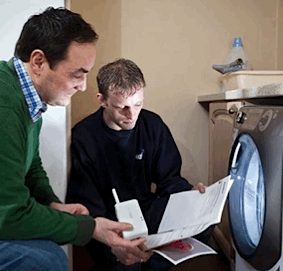 The washing machine informs the consumer via an LCD display about how much the washing cycle would cost at the given moment and provides with alternative, cheaper options. Most of these options will propose waiting until off-peak hours when the general demand is lower. How this will fit with the general feeling that running appliances unattended remains to be seen as most manufacturers advice against unattended use (pros and cons of delay start).
“With this washing machine trial, and lots of other trials as part of the CLNR project, we will begin to see how flexible customers are willing to be in terms of when and how they use their electricity,” said Allan Row who is the Low Carbon Networks Fund project manager for British Gass – one of the project’s coordinators.
“We want to develop an understanding of the role customers could play in the UK’s low carbon future, looking at whether they are happy to change their usual routines because it will make their bills cheaper, or because they’re offered an incentive by their network,” he said
The pressure on the already tested electricity network is expected to increase as more people move towards electric vehicles and installing solar panels. The smart appliances offer a tool to electricity network operators to contact the consumer directly via the appliance with an incentive to wait. An overloaded electricity grid operator could, for example, offer a reduced tariff if the costumer is willing to do the laundry at a less busy time.
“We are excited that the CLNR project is exploring the intelligence of our Hotpoint Aqualtis smart washing machine,” says Stefano Frattesi, Indesit’s Technology Center Director. “We have made pioneering progress in the field of smart grids and this new trial brings huge possibilities in terms of energy savings, confirming our commitment to innovating to benefit the environment.”
During a 12-month trial period, British Gas will work with two groups of customers, monitoring their behaviour. The first group will be on a ‘Peak Electricity Saver’ trial and has been assigned a time-of-use (TOU) tariff to help develop a greater understanding of how cheaper tariff times impact their electricity consumption.
The second group of customers will be on the ‘Energy Supply Manager’ trial and has agreed to ‘demand side response’, providing the network operator with the ability to ask the customer whether they would consider rescheduling the time at which they have programmed their washing.
Recruitment for households to take part in the washing machine trials is ongoing, but is restricted to British Gas customers who receive their electricity via Northern Powergrid, the electricity distributor for the Northeast and Yorkshire.
Several other trials are currently taking place in the same region as part of the CLNR project, involving other ‘smart’ technology.
There are some doubts about these smart systems however as, although they are touted to owners as being in place to save energy and therefore money, the cost savings seem to be marginal at best and can be restrictive. There has been recent critisism in the media over such systems controlling appliances such as fridge freezers and more due to the requirement to manage our use of power better.
Whether people will pay the premium for such products and, accept the limitations remains unknown.