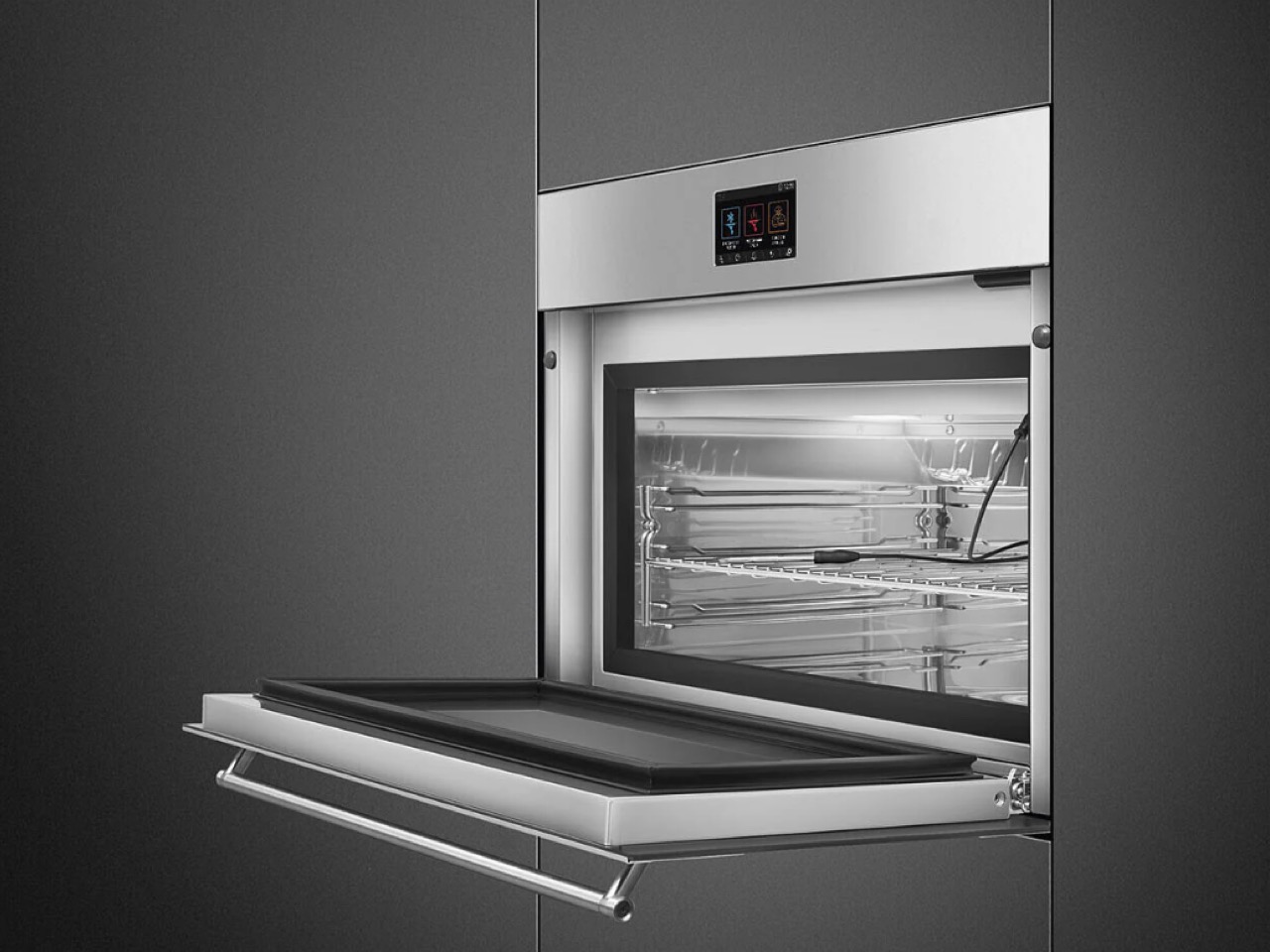

Smeg, the Italian manufacturer, famous for its elegant and distinctive domestic appliances, has used Maginus solutions in its UK subsidiary since August 2005. Maginus has enabled Smeg to make significant improvements across sales, logistics and fulfilment.
Smeg manufactures all of its products in Italy, with sales and distribution managed by subsidiaries across Europe. Smeg UK is the company’s largest operation outside Italy. It’s a business-to-business distribution company that sells through many different channels, including kitchen studios, electrical retailers, web retailers, contract house builders and department stores.
The relationship with Maginus began when Smeg set out to improve efficiency, accuracy and responsiveness throughout its order-to-delivery process. In particular, Smeg wanted to integrate its sales function more tightly with logistics, integrate its UK operations with manufacturing in Italy, and reduce administration overheads for its multi-channel distribution business.
“We chose Maginus because of its clear focus on the requirements of our wholesale distribution business. We looked at other solutions, including Microsoft Business Solutions, but only Maginus had both the functionality we required and the understanding of the distribution market” said Simon Jarvis, IT Manager at Smeg UK. “Using Maginus has made a real difference to efficiency in sales, logistics and fulfilment, and this has translated directly into cost savings. The flexibility of the system means we can continue to find new ways to improve our operations, too.”
Improved sales visibility and performance
Smeg UK has a 22-strong sales team that focus on its various distribution channels. Using Maginus has improved their visibility of stock levels in the main warehouse in Portsmouth, as well as in warehouses in Italy. Inventory data from Italy is imported into Maginus on a daily basis with details of the manufacturing schedule, which means sales staff can give customers much more accurate information about the availability of products.
“Maginus also provides an “˜allocation horizon’, so if we take an order that doesn’t need delivering immediately; the stock isn’t tied up until it needs to be. For example, if we have an order for delivery in 1 months’ time, we can rely on the next shipment from Italy to satisfy that. So stock currently in the warehouse is therefore available to satisfy day to day requirements from our customers” said Simon Jarvis. “This capability didn’t exist before Maginus: our sales teams had to remember to input the order nearer the required delivery date which inevitably introduced errors.”
Efficient order processing
Orders generated by the sales force are processed by eight dedicated staff. Smeg have around 200 orders per day but the challenge lay in the size and complexity of the orders. Each order can have 100 or more lines and products require options and mandatory accessories. For example, a cooker may require a splash-back, which is available in two sizes.
“Before Maginus our sales order entry staff had to deal with these product configuration issues manually,” Simon Jarvis said. “With Maginus, the system manages linked products and mandatory accessories automatically. This increase in efficiency and accuracy has increased our order throughput by 15 per cent using the same number of staff.”
Some sales channels have specific requirements. For example, house builders typically offer Smeg appliances as packages that house buyers can choose from, with options to upgrade or add in products to create their ideal kitchen. Maginus makes it possible to set up these packages and options as product “˜kits’ designed for different house builder customers, and Smeg has successfully tested this functionality with a view to adopting it in future.
Increased control of pricing and customer information Using Maginus gives Smeg full control over the pricing process. Pricing is complex, with different discounts negotiated for different distribution channels and a wide range of products and options. Maginus gives Smeg the control it needs and makes it easy to update pricing changes in the system quickly and accurately.
Maginus also gives Smeg a single source of customer information. Each customer account has one invoicing address but can have any number of delivery addresses, and multiple contact names and numbers. Previously, Smeg had to set up each delivery address as a separate customer record.
More efficient warehousing
Using Maginus has helped Smeg make dramatic improvements to its warehousing operations. Maginus allows the company’s warehouse manager to manage future load planning, by showing orders due in the coming weeks. The system generates reports that show which products need to be moved from Smeg’s buffer warehouse to fulfil orders. It only highlights products that are available in the buffer, which means the warehouse manager is able to focus on priority low stock situations and ensure the main warehouse is able to fulfil demand. If a product is out of stock in the buffer it is sourced directly from Italy: information about stock levels and orders are automatically exported to the parent company’s back office systems.
Using Maginus has also improved the returns process. Before Maginus, goods were invoiced at the point of despatch. That meant that if a delivery failed, staff had to credit the customer’s account and raise another order on the system, by which time the product in question may well have been allocated to a different customer. With Maginus, the order is picked from the despatch note, the pick list is updated and the invoice is generated by delivery confirmation. This is much more accurate and efficient and also helps improve service for customers.
“Picking accuracy has increased to 99.9 per cent using Maginus,” said Simon Jarvis. “Back to back orders are easier to manage, and orders can now be shipped complete or incomplete, which increases our flexibility and improves service for customers.”
Improved reporting and intelligence Using Maginus has also given Smeg a major improvement in the quality of management information. Using the Maginus Report Writer, the company can generate a large number of reports in-house, and make them available to any Maginus user without needing to rely on expensive additional reporting software. Reports can be distributed via email, mobile phone or made available to run within the main Maginus system.
With Maginus, sales reports are run daily and emailed automatically to the sales team, who can also run the reports manually within Maginus if they choose and drop the information into Excel for example. This gives the sales team much greater access to information and allows them to present the information in a more professional manner to customers. At the same time, Smeg’s Sales Director has access to a wide range of intelligence on sales performance, which helps the company meet revenue targets and manage the salesforce more effectively.
Continuous improvement
“We’re extremely happy with our Maginus solution,” Simon Jarvis concludes. “It’s a flexible and efficient system that’s designed around our needs as a distributor, and it’s delivered real benefits to the business.”
Future plans include the use of “˜Pocket Maginus’ to collect proof of delivery notices, and increased use of Maginus marketing functionality to control campaigns and use media codes to track their success. Working with Maginus, these continuous improvements in efficiency are set to help Smeg maintain its position as a leading appliances provider in the UK.