
LG Electronics’ boasts cutting-edge technology products but the item that really catches consumers’ fancy is something often shoved out of sight – the humble washing machine.
Mobile phones, digital televisions and plasma display panels do not come close to the sales growth achieved by the company’s drum, or front-loading, washers.
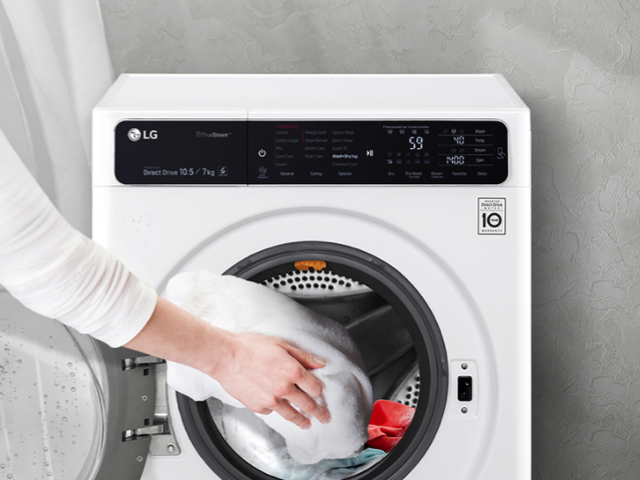
In just four years, LG Electronics has gone from a new player in drum washers to the dominant seller, boasting a 70 percent market share with 315,000 units sold annually, with its top-ranked flagship TROMM model leading the soaring sales.
Moreover, the company has redefined the washing machine market in general. While total shipments of washers in Korea has hovered around 1 million units in recent years, a reflection of a mature sector where demand hardly budges, the drum model has increasingly become the preferred choice.
LG’s advance suggests a textbook lesson in product adaptation, pricing strategy and profitability from a traditionally low-margin product.
The portion of drum-type models to total washer shipments in Korea rose to 45 percent last year from 23 percent in 2002. This year the figure is expected to reach 60 percent, or about 650,000 units, says Yoon In-duk, a manager at LG Electronics.
Unlike conventional models that are typically placed in a storage room or bathroom, drum-type washing machines are smaller and fashionable and make less noise.
Apartment dwellers are now eager to put upscale drum washing machines in their kitchen alongside refrigerators, and magazines catering to homemakers often put LG’s drum washers in their interior feature articles.
Success came on a gamble.
LG first began selling drum washers in Europe. Unlike its competitors, the company’s model featured a power system that directly linked the motor to the clothes-holding drum. The result was a quieter washer and few mechanical problems, compared to rivals’ motor belt system.
“We figured that mainstream drum washers in Europe were fraught with noise and short lifespan because of the belt system, but the new technology developed by LG resolved the problems, opening up a new market there,” says Cha Woong-kil, senior research engineer at the engineering design department of LG’s washing machines division.
LG said the technology led to numerous price and “best buy” designations on overseas markets such as France, Belgium, Britain, the Netherlands and Australia. Last year, the company also received the National Award from Energy Efficient Strategies in Australia.
By 2000, flush with overseas success, LG’s washing machine engineers and marketing staff considered launching drum washers in Korea. But some company officials were skeptical. At the time, drum washers were regarded as a premium product. Only expensive, imported drum washers were available locally and sales were lackluster.
“It was just like gambling since it was not considered a lucrative market at all,” says Cha.
Since mainstream consumers had looked past expensive drum washers, LG decided it first had to educate potential buyers. Another concern was the company’s image if the drum washer failed.
When first introduced, TROMM washers were sold at slightly more than 1 million won or higher. The price range was designed to maintain an upscale brand image but was still significantly less expensive than foreign brands sold at high street department stores.
Another focal point was the drying function. Foreign drum washers were relatively poor at drying and LG knew it could differentiate its products if it improved the feature. Korean customers, particularly those who live in apartment complexes, prefer a powerful drying function.
Due to limited space, drying clothes on a veranda is cumbersome and time consuming. But the powerful drying ability of the latest TROMM models eliminates the burden and is a key selling point for mainstream users.
LG officials said its choosing the name TROMM helped its drum washers beat its competitors on the ferociously competitive market. TROMM, taken from the German root word for drum or barrel, evokes a European style and image and sounds like drum, a marketing trick that turned its original brand into a sort of representative product name identified with drum washers.
Another point was that LG avoided putting its company logo and brand up front on purpose. It stressed just the TROMM name without showing its LG brand and a number of buyers in the early stages bought the machines believing they were foreign-made.
What industry analysts find most impressive is how LG squeezed fresh value from an unsung appliance. Normally, washing machines have low profit margins because of market saturation – nearly every household has one.
Reflecting the fast penetration of drum washers, the prices are quickly dropping. Just a year ago, the TROMM was priced at more than 1 million won but now sells for around 800,000 won.
Still, the margin on drum washers is far greater than from conventional top-loading models, propping up profitability at LG’s home appliance division.
Analysts said the success of the company’s domestic drum washer market is fueling its export campaign. Lee Tae-jin, manager in charge of exports for the North American market, says shipments of LG washers to the United States, which started in 2002, were valued at $30 million last year and are expected to go up to between $70 million to $80 million this year.
“The drum-type washer machine is still in its infancy in the U.S. market, with LG’s share standing at just 2 to 3 percent, but the market is expected to grow quickly as the overall trend is moving in that direction,” Lee says.
But LG’s aggressive export drive to the U.S. market has sparked a challenge. U.S.-based home appliance giant Whirlpool announced Feb. 13 that it has filed a second patent infringement lawsuit against LG Electronics and its U.S. affiliate, LG Electronics USA Inc., over clothes washer patents.
Whirlpool claims in its latest suit that a line of LG washers sold in the U.S. infringes on two patents held by Whirlpool to protect its washing technology – a method of rolling clothes in the washer for better cleaning while using less energy and water.
Whirlpool filed a similar suit in August last year on claims of another washer patent violation.
In both cases, the company asked the U.S. court to force LG to remove the washers in question from distribution and pay damages resulting from the alleged infringements.
LG officials would not comment on the patent disputes.
Analysts point out that Whirlpool’s move should not pose a major threat and its legal challenge shows its anxiety about LG’s fast expansion in the sector.
“The recent surge in exports of LG washers is clearly making Whirlpool take issue with some patents but its negative impact may be minimal since LG has been in the washing machine business for a long time and knows how to handle such disputes,” says Michael Min, head of the electronics sector research at Tong Yang Investment Bank.
Samsung Electronics Co., Korea’s largest appliance maker, has also taken notice of the drum washer popularity. Last week, it said it would manufacture a new drum model for Maytag Corp., a major U.S. appliance company, over the next five years.
Samsung officials said the companies expect to sell 500 billion won ($425.5 million) in high-end laundry machines and dryers worldwide during the venture.
From The Korean Herald